The week in voice translation was one model: Gemini 3.5 Live Translate from Google. It launched in June, and through August it stopped being a preview and started being the default inside Google's products. Five updates, and what each one changes for you.
1. Google Translate got live translation globally
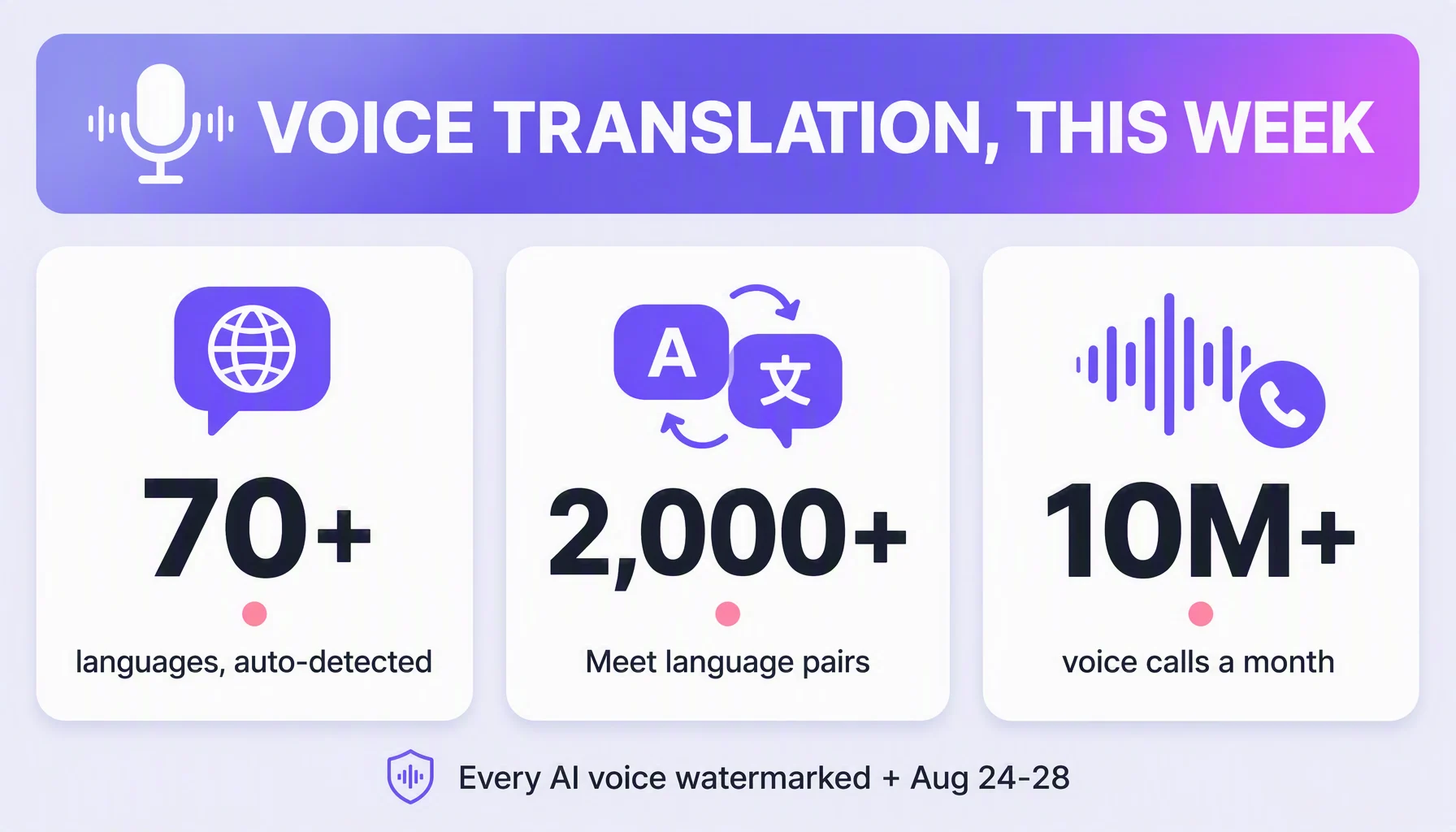
Google's official announcement confirmed a global rollout of Gemini 3.5 Live Translate inside the Google Translate app on Android and iOS, with a new "listening mode" on Android that plays live captions through headphones or the phone speaker. The model detects 70+ languages automatically, so users stopped configuring language pairs before talking.
What it means for you: Google Translate now covers live conversation with no setup — but the conversation happens inside Google Translate, and your audio goes with it.
2. Google Meet speech translation jumped from 5 to 70+ languages
The same model took Meet's speech translation from 5 bidirectional languages (English plus Spanish, French, German, Portuguese, Italian) to more than 70 languages and 2,000+ language pairs, with no need to route translations through English. It started as a private preview for selected Google Workspace business customers in June and kept widening in August.
What it means for you: a meeting no longer needs English as the middleman, which makes the real question which app you let into the meeting room.
3. Developers started plugging it into their own products
The model reached public preview through the Gemini Live API and Google AI Studio, and real-time media platforms integrated it — Agora, Fishjam, LiveKit, and Pipecat are named in Google's own materials.
What it means for you: translation became a building block that ships inside other products, not a feature you wait for.
4. Watermarking AI voices became a compliance feature
Every audio stream from the model carries SynthID, an imperceptible watermark embedded in the waveform and verifiable with Google's tools.
What it means for you: a translated recording can now be shown to be AI-generated — which matters when a meeting is a record, not just a chat.
5. Real deployments started showing up
Grab — whose app handles more than 10 million voice calls a month, per media coverage — is testing the model for direct multilingual conversation between drivers and riders. Korean entertainment company CJ ENM publicly praised the translation quality and latency. In both cases the testing is happening in service.
What it means for you: a driver-to-rider conversation with no shared language is the shape of the use case a dedicated voice translator is built for.
What this means for your conversations
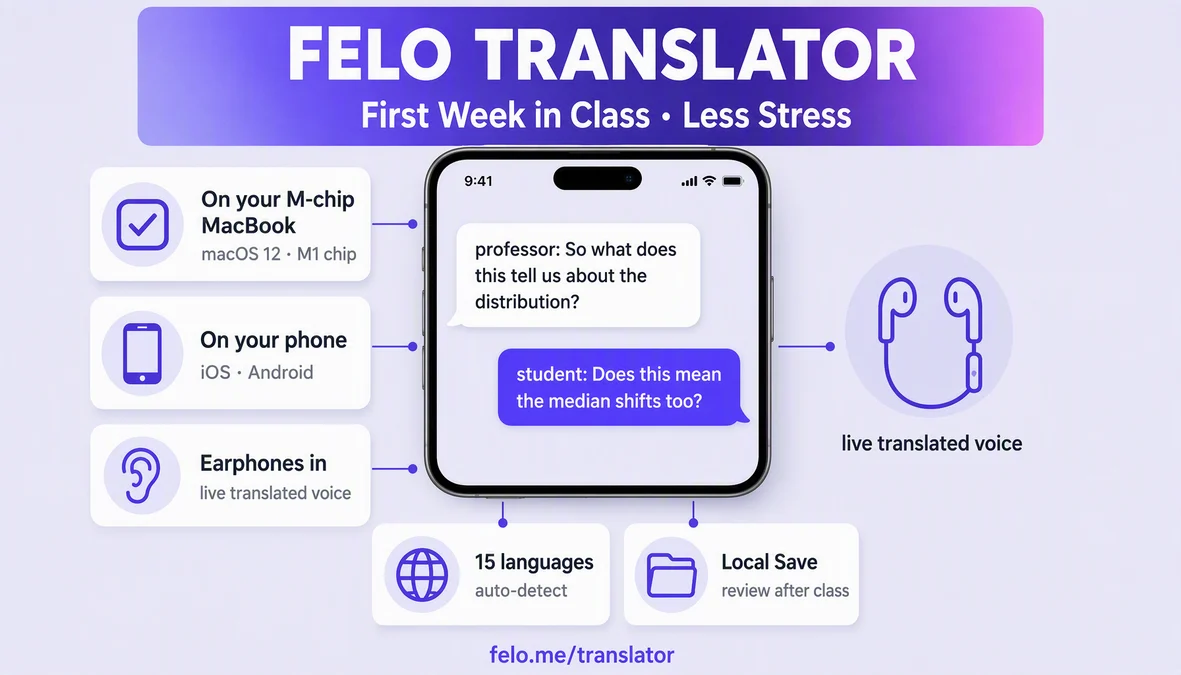
Felo Translator's position is unchanged, because its job is a different surface: real-time voice transcription and translation across 15 languages (Korean, Japanese, German, English, Simplified Chinese, Czech, Thai, Spanish, French, Taiwanese Mandarin, Italian, Russian, Cantonese, Indonesian, Vietnamese), with natural-sounding translation reading and on-device saving, on iOS and Android with a free trial, as listed on the official felo.me/translator page. Google's rollout covers conversations inside Google's apps and Meet; Felo covers the ones where your phone is the only device in the room — the café, the taxi, the clinic, the family call. When a platform's default becomes live translation everywhere, the dedicated app matters more, not less.
FAQ
Does Google's rollout replace dedicated voice translation apps? No — it replaces the need for a translation feature inside Google's products, for conversations that happen there. Dedicated apps serve the conversations outside: no sign-in to the same ecosystem, a focused voice pipeline, and on-device saving of the conversation.
Is watermarking on AI voices new? No — SynthID watermarks were announced by Google previously. What changed is the context: with audio streams generated as a default inside a live translator, provenance became an operational requirement.
Should I still install a dedicated voice translator? Probably not, if your conversations mostly happen inside Google's apps and Meet. If you translate face-to-face conversations where only your phone is present — travel, clinics, markets, family calls — a dedicated app is built for those moments. Felo Translator's support list is 15 languages, so check your pair first.
By the Felo Editorial Team. The Felo Editorial Team writes about language, voice translation, and the details of talking across borders.