If you sit in an international school or a bilingual-stream class and the lesson runs in English while your first language is something else, the useful move is not to translate everything as it happens. It is to set one thing up before the bell, run live captions during the lesson, and finish the parts you missed at home. Start with your teacher, not with the app.
Before the first lesson: three things to settle
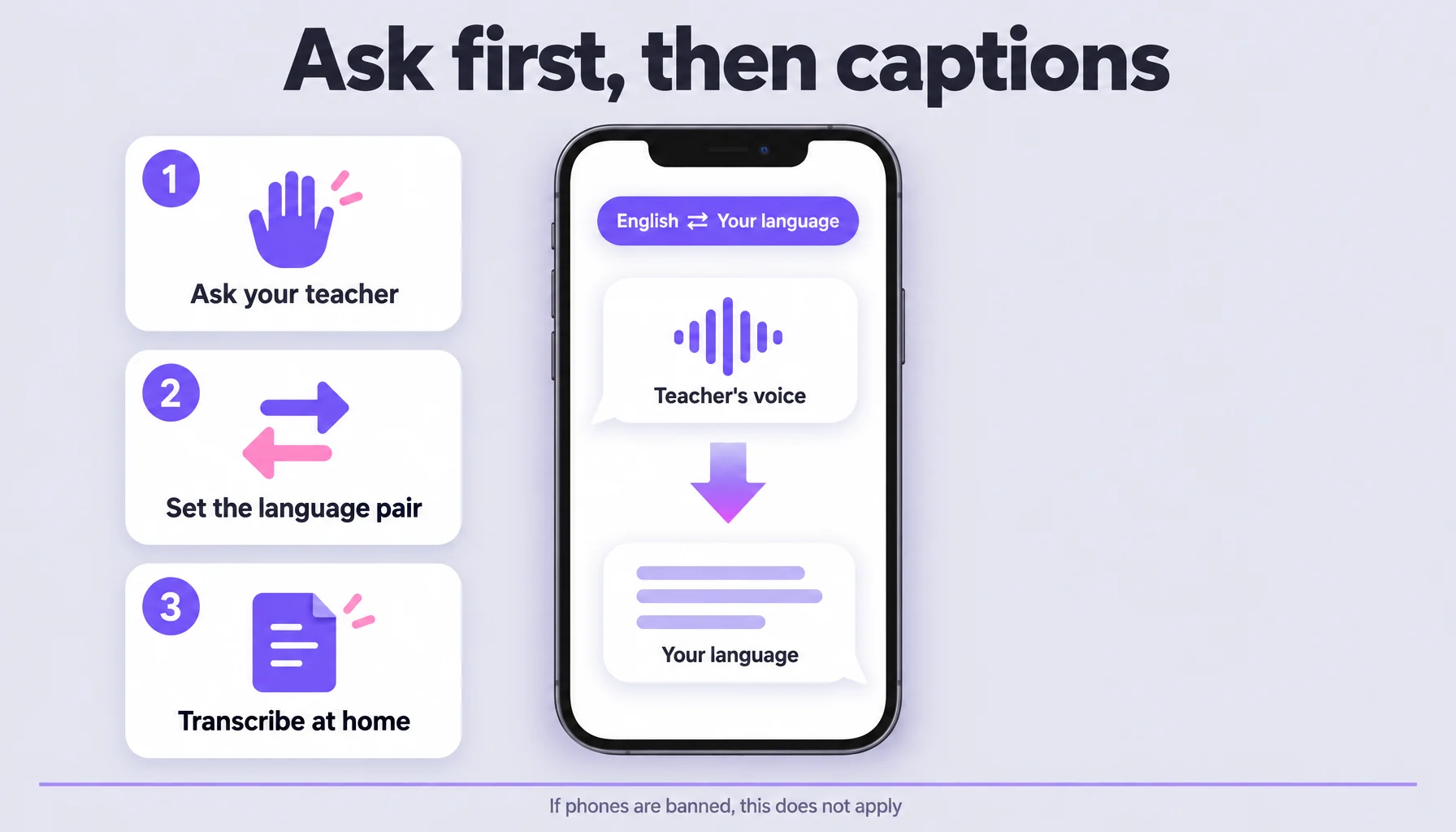
- Ask your teacher, and ask one lesson ahead. This is not a formality. Teaching staff are the ones who know the school's rule, and in most secondary schools that rule says something about phones during lessons. Ask a specific question: can I keep a phone on my desk with live translation running? If the answer is no, that is the answer — an app is not a way around a school rule, and using one anyway puts you in a worse position than not understanding the lesson.
It is worth asking about subtitles and recording separately, because they are not the same thing. Live subtitles show text on your screen and store nothing. Recording keeps audio. Your teacher may allow the first and refuse the second, and that is a reasonable position.
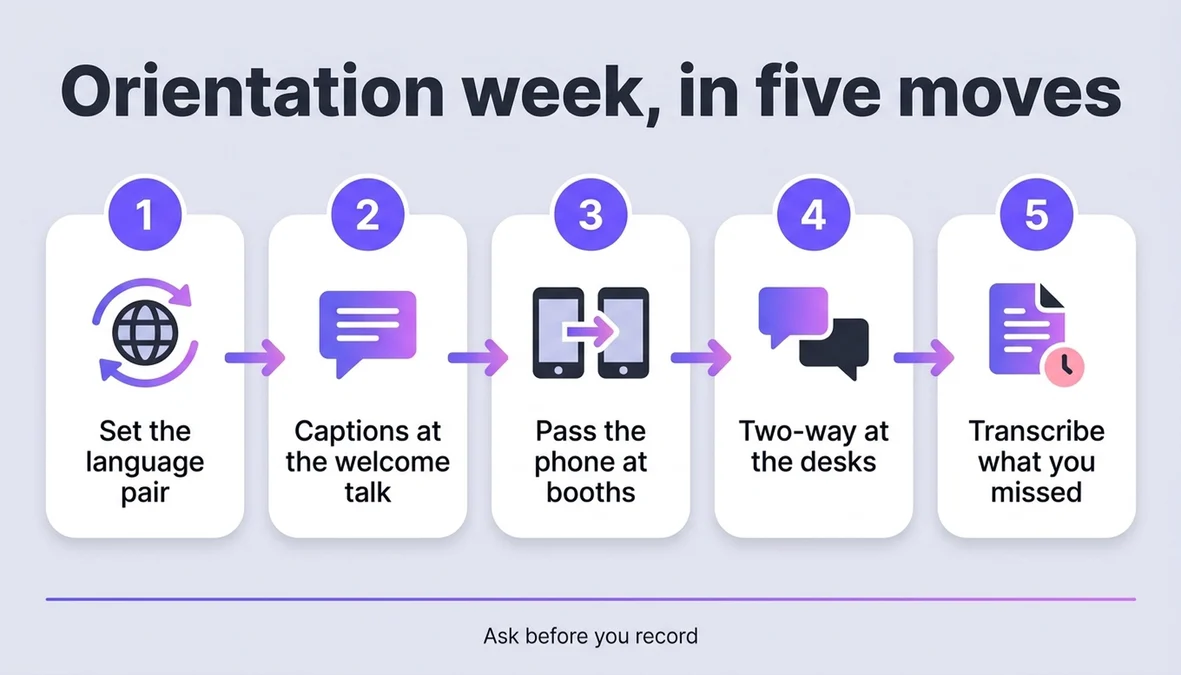
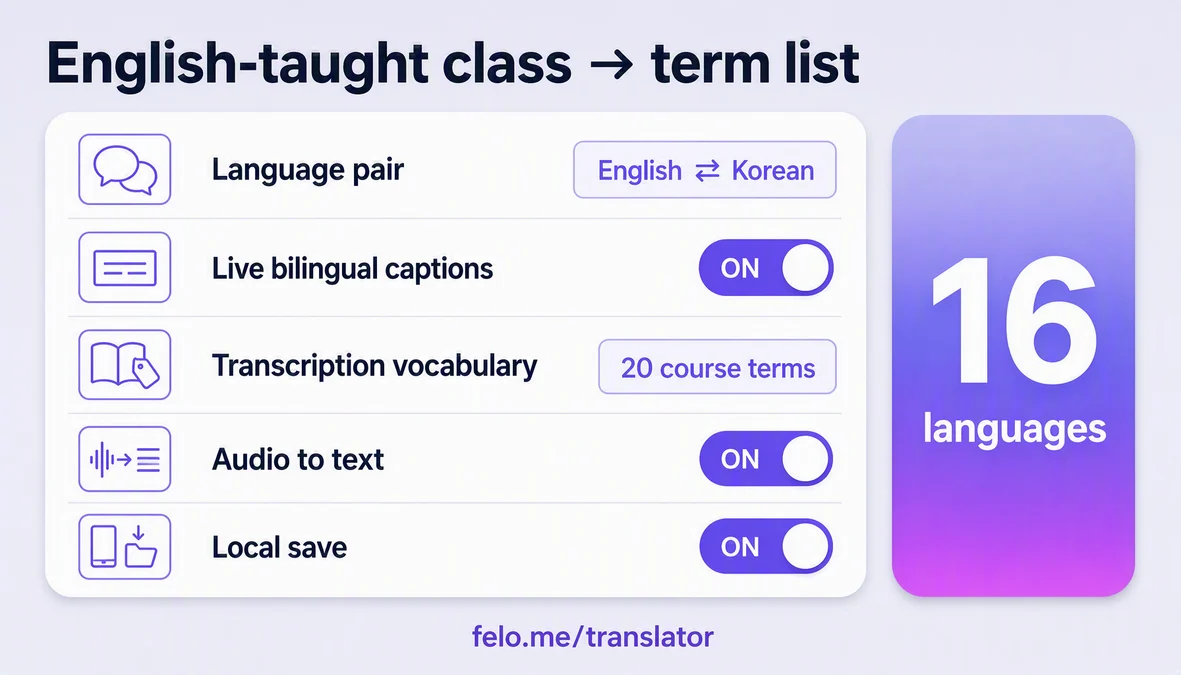
- Set the language pair, and check both languages are on the list. Felo Translator covers 16 languages for real-time voice translation: Korean, Japanese, German, English, Simplified Chinese, Taiwanese Mandarin, Cantonese, Czech, Thai, Spanish, French, Italian, Russian, Indonesian, Vietnamese, and Nepali. Set it to English ⇄ your language in advance. Doing it under the desk while the teacher is already talking costs you the first three minutes of the lesson.
- Battery, position, and sound. A phone translating for forty minutes drains faster than you expect, so start the day charged. Put the phone where you can read it and where your teacher can see it — a screen angled away from the room looks like hiding even when it is not. Turn the volume down or use one earbud; a second voice reading the lesson out loud is a distraction to everyone around you.
How to run it through a lesson (7 steps)
- Start the translation before the teacher starts talking. Set the pair, check that the microphone is picking up the room, and leave the phone flat on the desk. Say something yourself first, quietly, to confirm it is live.
- Read the captions, do not copy them. The captions are there to stop you from losing the thread, not to replace your notes. If you spend the lesson copying translated text, you will miss the lesson.
- Mark the moments that matter. When the teacher repeats something, writes it on the board, slows down, or says it will be on the test, write a timestamp in the margin of your notebook. That single number is what lets you find the passage again later.
- Check the questionable sentence on the spot, if your teacher allows it. If you lose one specific instruction — a page number, a deadline, a task — read it in the transcript while the lesson is still running. Most of the value is in catching one lost sentence before it becomes a lost assignment.
- At home, run the lesson audio through transcription. Play the recording back through Felo's audio-file transcription and you get a bilingual transcript instead of a stream of captions you can no longer see. This is the step that turns a lesson into study material.
- Do the same with listening homework. If your teacher sends an audio file, a podcast, or a listening exercise, transcribe it before you answer the questions. Reading the passage you could not quite hear is the difference between practicing listening and guessing.
- Save the transcript with a name you will recognize. Felo's Local Save keeps transcripts on your own device. Name them by subject and date, not "recording 4" — in November you will be looking for the one about the water cycle, not the fourth file of the term.
A small sample of what the captions look like in practice, when the teacher is giving instructions:
"Take out the green booklet and read the second passage — I'll give you ten minutes, then we'll go through it together."
"把绿色那本练习册拿出来,读第二篇——给你们十分钟,然后我们一起过。"
Three moments it earns its place
The lesson where the teacher tells a story to explain a concept. This is the hardest listening in school: no textbook, no slides, no chance to look anything up, because the meaning is in the telling. Captions catch the story, and the transcript lets you read it again slowly at home.
Group work and lab sessions. When classmates discuss among themselves, the language is fast, idiomatic, and full of half-sentences. Being able to read back what the group decided is worth more than following every word in real time.
The listening exercise you have to answer questions about. Reading a transcript of the passage you just heard is not cheating on listening practice — it is how you find out which words you actually missed, which is the part that improves.
Make it smoother
- Set the pair as English ⇄ your own language, not English ⇄ English. It sounds obvious and it is the most common setup mistake.
- Learn to expect names and subject terms in the original. A person's name, a chemical, a historical figure, a formula — these often stay as they were said, because a translation would make them harder to match to the textbook, not easier.
- Sit where the teacher's voice reaches you cleanly. Near the front, off the side where the air conditioning or the corridor noise comes from.
- Keep one notebook for timestamps only. A page of numbers next to your notes is faster to search than a page of half-written words.
- If the captions start lagging behind the teacher, stop reading for a moment and let them catch up. A lagging caption read as if it were live will confuse you more than silence.
What it won't do
- It is not an official translation. Exam instructions, report cards, medical notes, anything your family has to sign — the school's own written document is what counts. If a piece of paper matters, ask a person about the paper.
- It does not override your school's phone rule. If phones are not allowed in your lessons, this whole setup does not apply to you, and no app changes that.
- A recording captures your classmates, not just the lesson. Their voices are in there too, and for students your age that information is protected more strictly than an adult's. Record the room, not the people in it, and only with your teacher's agreement.
- It will not make a hard lesson easy. Understanding a lesson in your second language is work even with good captions. What the setup removes is the small losses, not the effort.
- It can distract you. If watching captions means you stop watching the teacher, turn the phone face down and take notes the ordinary way. The app is only useful when it leaves you better off than not using it.
Where Felo fits
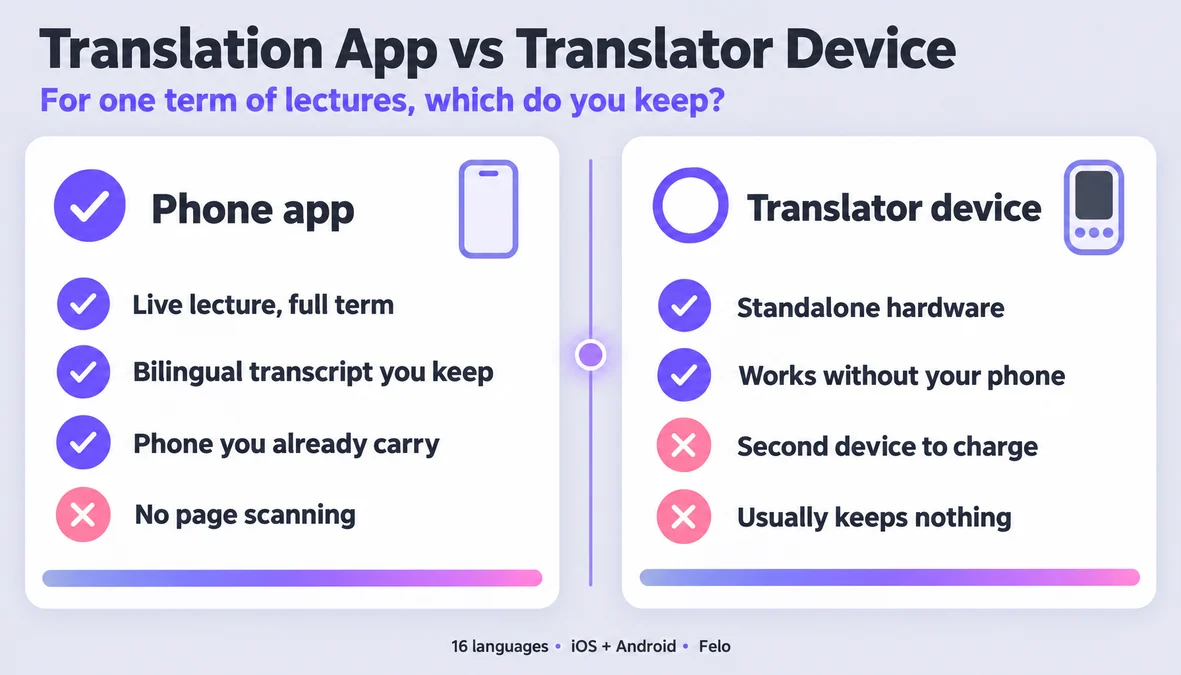
Felo Translator is a real-time voice translation app built for exactly this situation: a conversation happening now, in a language that is not your strongest one. It translates 16 languages as speech, produces bilingual transcripts of what it hears, transcribes audio files you already have, and keeps saved transcripts on your own device with Local Save. It runs on iOS and Android (with an APK for regions where Google Play is unavailable), and it does not need an account.
What that means for a school day is narrow and specific. You are not translating a document — you are keeping up with a voice in real time and keeping a record of it. It is the difference between finishing a lesson with a page of guesswork and finishing it with a transcript you can read tonight.
FAQ
Can I record my class with Felo?
Ask your teacher first, every time, and ask before the lesson rather than after. If your school does not allow phones in lessons — and many do not — then the answer is no, and Felo is not a way around it. Also ask about subtitles and recording as two separate things, since a teacher may allow one and not the other.
What do I need to run it?
A phone, the app, and a language pair. Felo Translator works on iOS and Android, does not need an account, and translates 16 languages: Korean, Japanese, German, English, Simplified Chinese, Taiwanese Mandarin, Cantonese, Czech, Thai, Spanish, French, Italian, Russian, Indonesian, Vietnamese, and Nepali. If you are setting it up for the first time, do it the evening before, not in the corridor.
Will it translate my teacher's English into my language?
Yes, as live captions and as a bilingual transcript. Expect names and subject-specific terms to stay close to the original — a translated chemical name is harder to match to your textbook than the one your teacher actually said.
How is this different from a translation of a school document?
A school document — a report, an exam instruction sheet, a permission form — has an official version, and that version is the one that counts. Felo translates speech as it happens and gives you a transcript to study from. It is a study tool, not a certified translation, and nobody at your school is obliged to accept it as one.
By the Felo Editorial Team. The Felo Editorial Team writes about language, voice translation, and the details of talking across borders. Felo Translator is a real-time voice translation app in 16 languages, at [felo.me/translator](https://felo.me/translator).