The first week of classes taught me to follow a lecture. Then the seminar started, and I found the real test: six students around a table, the professor turning to me with "so — you disagree with Sofia?" and by the time I had translated the offer, connected it to the argument, and composed a sentence, the room was already on the next topic. I wasn't lost. I was late — every single time.
So this is the sharing for the moment the first week ends: the same Felo Translator setup, used not for listening to a lecture but for staying inside a conversation. A live voice translation app with a language pair set and an earphone in gives me the translation about half a beat after each speaker finishes — and half a beat is exactly the head start a discussion needs.
Before the round table: 90 seconds of setup
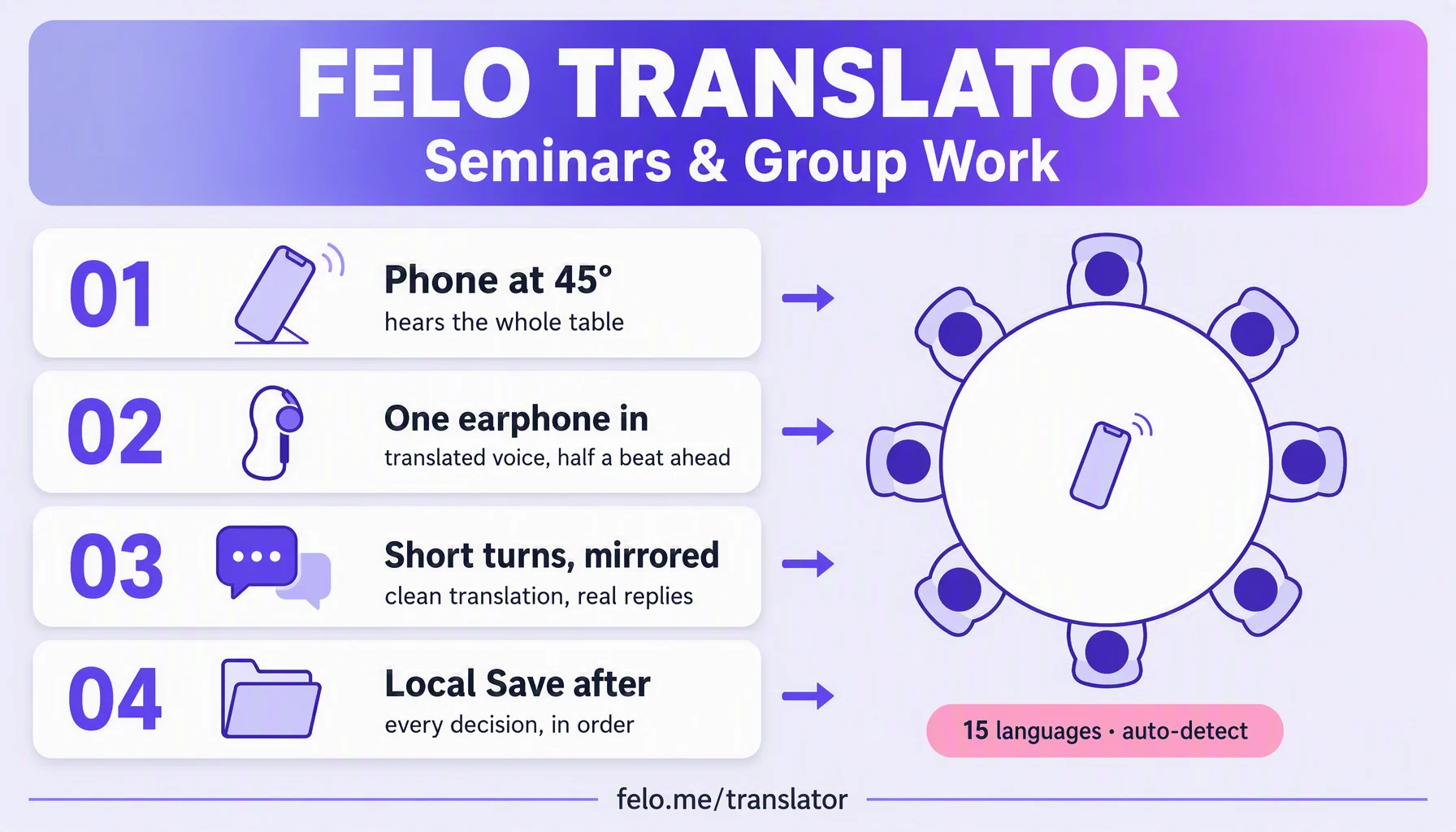
- Same app, same pair, one change: position it like a mic. The app says it automatically detects the languages spoken by both parties, so the conversation works both ways. At a seminar table I place my phone on the table, tilted at 45° toward the middle of the group — not toward me. The mic that hears my friends hears the professor.
- One earphone in before anyone sits down. Discussion is turn-taking, not a monologue; the translated voice comes through one ear while the other stays on the room. When the group sizes up and notices the earphone, a one-line explanation makes everything smoother: "I'm following you in translation — talk to me like I'm a runner, short sentences."
- Check the volume with one line of the syllabus. The reading should land at a level where a fast speaker doesn't suddenly spike. Ten seconds of test at the table while people are still finding seats saves the first five minutes of the seminar.
When the discussion actually starts
- Start a session while the professor is still on the first slide. One live conversation at a time — the app listens, transcribes, and translates as it goes, and the screen holds what the group is saying as text.
- Let the translation arrive before the sentence clicks. By the time the ear finishes a clause, someone in the room is usually already responding. The trick is not to wait for the sentence. The trick is to let the gap — half a beat — be your buffer.
- Answer in short turns, and prove you heard the person before you. Instead of a full paragraph, lead with a mirror: Sofia: "I think elasticity changes everything here." — you, eight words: "Even for a small bakery, right?" Short turns translate cleanly, and the mirror proves to the room you're not just dropping a prepared statement.
- Claim the mic with a permission line. When I need the turn, I raise my hand and say the thing itself: "Can I take this? — when you say bakery, I'm thinking of demand holding steady." The app turns my sentence into the discussion's language, and the screen shows both sides.
- In group project meetings, say the rule aloud once. "I'm using a live translation app — when I pause, it's the translation, not a blank." After that the group slows down for me automatically. Nobody minds giving a teammate's radio a clear signal.
- Skim the archived session at the end of the day. The app keeps conversations and translation content in Local Save automatically. Reading what the group actually decided — three people talking over each other, one name attached to each line — turned a messy hour into an action list I could actually execute.
- Prepare opinions ahead of the table. Ten minutes before the seminar, I write two short ideas in my own language, translate them once with the app, and keep the text on the screen. When the professor invites disagreement, I am not translating paper — I am reading my own scene.
Three places it did the most
The 90-minute round table. A small lecture hall broken into a circle, everyone competing with a different accent. The translated voice came in a half-beat behind each speaker, which meant my head was never two steps behind the conversation. Twenty minutes in, the professor said "you can disagree too, you know." I could finally hear the disagreement.
The first group project meeting. The team decided the briefing on the spot — "so three of us do analysis, and the presentation is Thursday, right?" The transcripts said it differently: nobody actually agreed, and the Thursday date landed on a person who had said "I can't do Thursday." The whole confusion was one email's worth of translation I had missed. The app didn't fix the meeting. It made the meeting legible.
The study group before the midterm. The group talked over each other; the app kept the order. One friend's suggestion got summarized on the screen while it was still being made. I had the notes of a group that no one else was keeping.
Why a translator app, not a voice recorder or a chat bot
A recorder gives me the lecture afterward, but not the awareness during it. A chat bot answers my questions, but not the room's. Felo Translator is built for the conversation itself: voice translation turns spoken turns into text instantly, translation reading carries the result to my ear with natural prosody, and local save keeps the conversation on my device. The official product page says the app automatically detects the languages spoken by both parties — that's why my half of the conversation can land in their language too. Fifteen languages, free to try.
What made it smoother
- Say "I'm the translator" at the table. It costs one sentence and converts the room's speed for me. Groups do not slow down for a silent person; they slow down for a stated one.
- Mine the turn before you speak. A two-word mirror ("even a bakery?") makes a cleaner translation than a full paragraph.
- Sit where the group is loudest. Not the back — the middle of the table. The mic hears what the room is doing.
- Watch the text, not the voice, when the group talks over itself. The text keeps the order that the ear loses.
- Save before the battery saves you. A seminar's conversation is two hours of mic. Charge before, not between.
Where it still hits the edge
- Five people overlapping don't exist for any translation app. No tool separates "Sofia's idea" from "Daniel's joke" when they arrive in the same second. The app keeps the first voice; the room keeps the chaos. Short turns are how I survive it.
- Translations travel in meaning, not in names and puns. A great joke about a professor's favorite opera singer — the translation keeps the structure and loses the whole bit.
- It's a live app — no signal, no session. Local Save keeps files on my device, but live translation needs the network. The basement seminar room is the one room I've learned to dislike.
- It changes how you join the discussion, not how much you can say. It buys me the turn; I still have to have something to say.
- School policy stays school policy. Ask about assistant apps before I commit to wearing an earphone in a quiz-adjacent class.
FAQ
How is this different from using the app at a lecture?
Same 15 languages and the same live translation; the difference is what it's pointed at. A lecture is one voice and a script, so the app follows. A seminar is many voices competing, so the app already needs fixed turns, planning, and a two-way pair.
Does my group mind that I'm using a translator?
Most groups want me on the table and will correct themselves when I ask. The record: of my four groups, none objected; one debated the translation's quality every meeting.
Can I use Felo Translator with a MacBook instead of a phone at a group meetup?
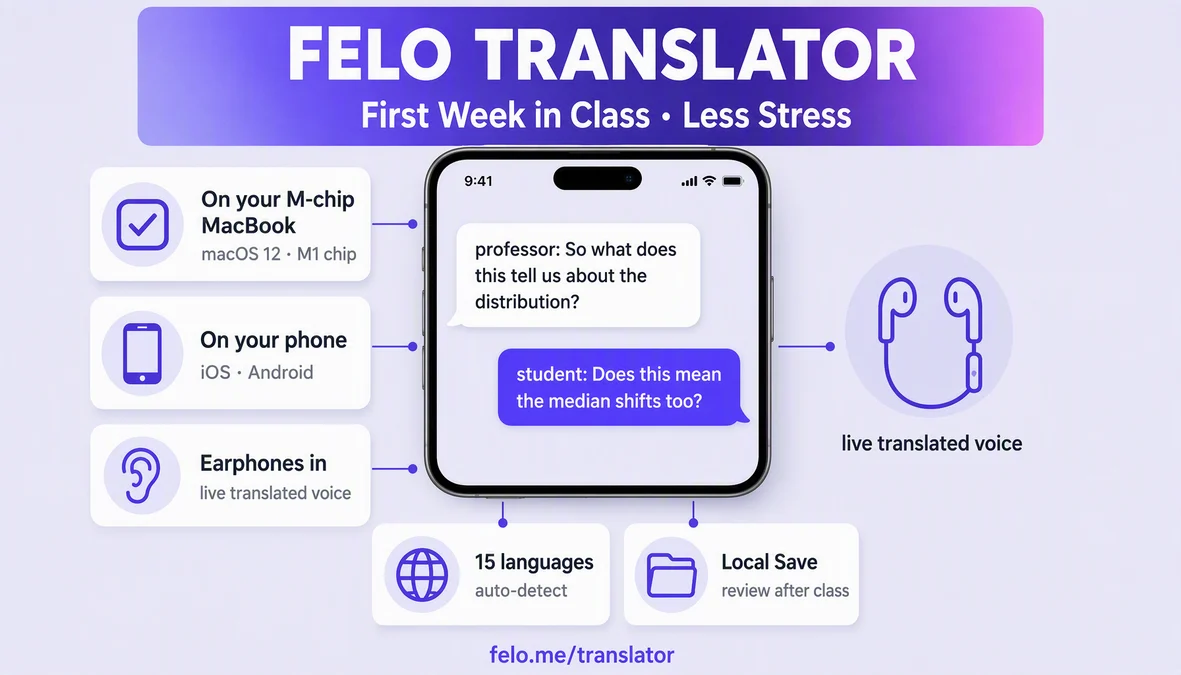
Yes. Install from the Mac App Store — it requires macOS 12.0 or later and a Mac with an Apple M1 chip or later, so any M-series MacBook works. Power users: the phone runs the live session, the Mac runs the transcript; I keep one at the table and open the other at home.
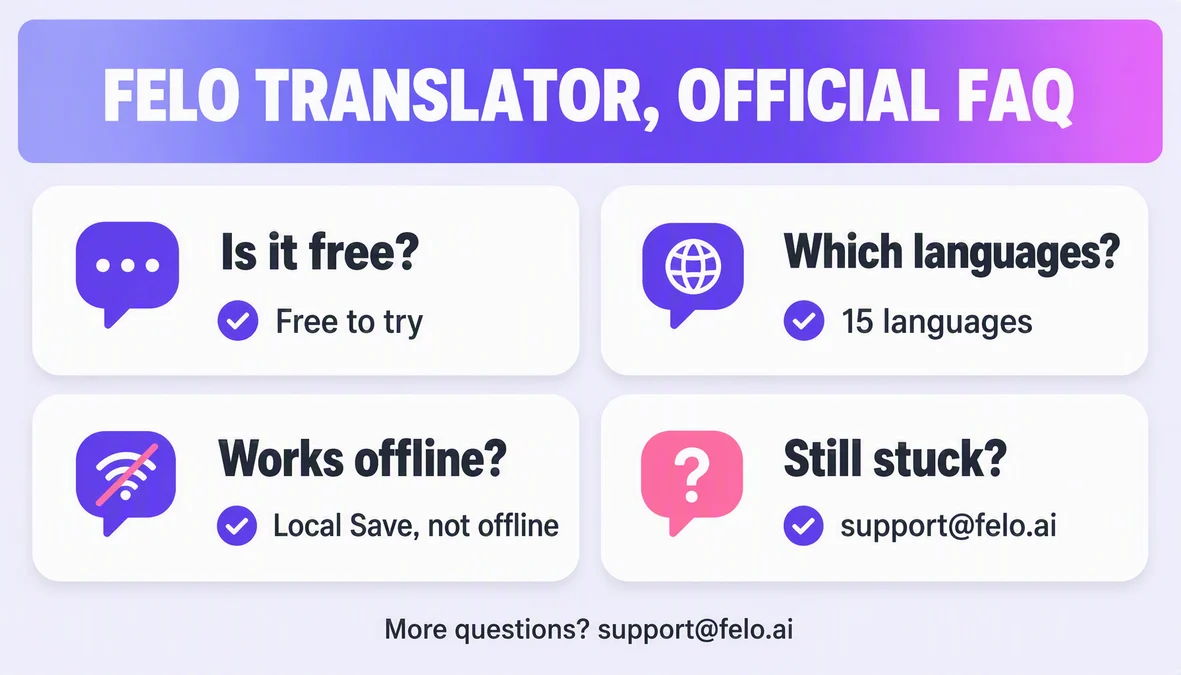
What does it cost for a semester of seminars?
Free to try. Pro is unlimited live voice translation and transcription — annual $239.99 USD (priced from $599), monthly $39.9 USD (priced from $59.9), plus a $0.99 one-day try-out and a $3.9 120-minute pack. I used the free try for the first two seminars; the only surprising part was how fast I stopped needing the transcript.
By the Felo Editorial Team. The Felo Editorial Team writes about language, voice translation, and the details of talking across borders. Felo Translator is a real-time voice translation app in 15 languages — try it free at felo.me/translator.