Real-time translation and simultaneous interpretation both let you communicate across languages without waiting — but they work differently and serve different situations. Real-time translation apps transcribe and translate as people speak, showing text on a screen. Simultaneous interpretation (done by human interpreters) translates speech in real-time, often with specialized equipment.
This guide explains the difference, compares accuracy and use cases, and helps you decide which approach fits your situation.
Before You Choose
Three things to consider before deciding:
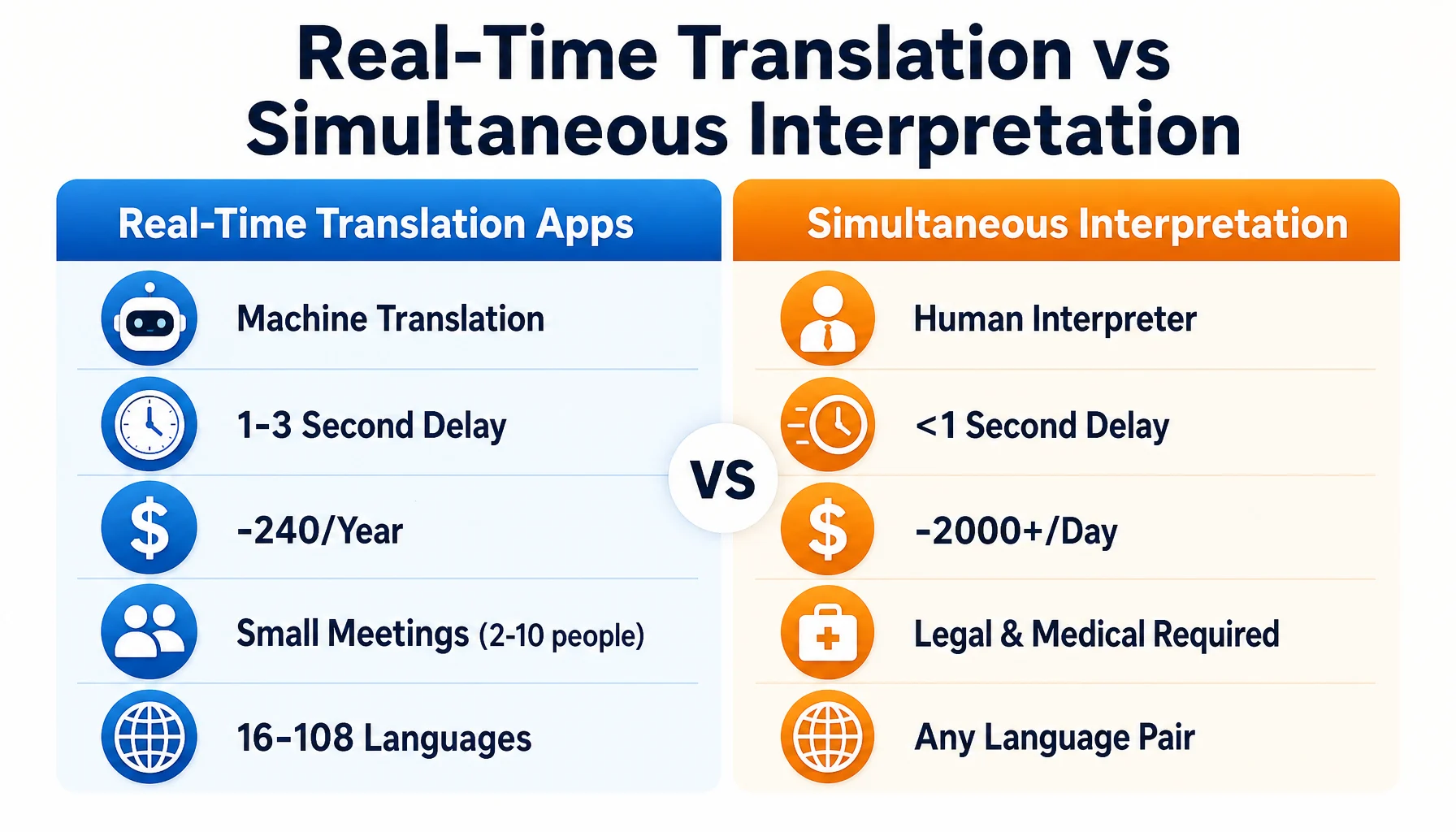
- Budget. Human interpreters cost $500-$2,000+ per day. Real-time translation apps cost $40-$240 per year. Your budget determines what's realistic.
- Language pair. For common pairs (English-Spanish, English-Chinese, English-Japanese), both options work well. For less common languages, human interpreters may be more accurate.
- Setting. Casual conversations, small meetings, and travel work fine with apps. Large conferences, legal proceedings, and medical consultations often require human interpreters.
What Is Real-Time Translation?
Real-time translation uses apps or devices to transcribe speech and translate it into another language as it happens. You see translated text on a screen (captions) or hear it through speakers, usually with a 1-3 second delay.
How it works:
- Speech recognition transcribes what's being said
- Machine translation converts the text to the target language
- The result appears as text (captions) or is read aloud
Common tools:
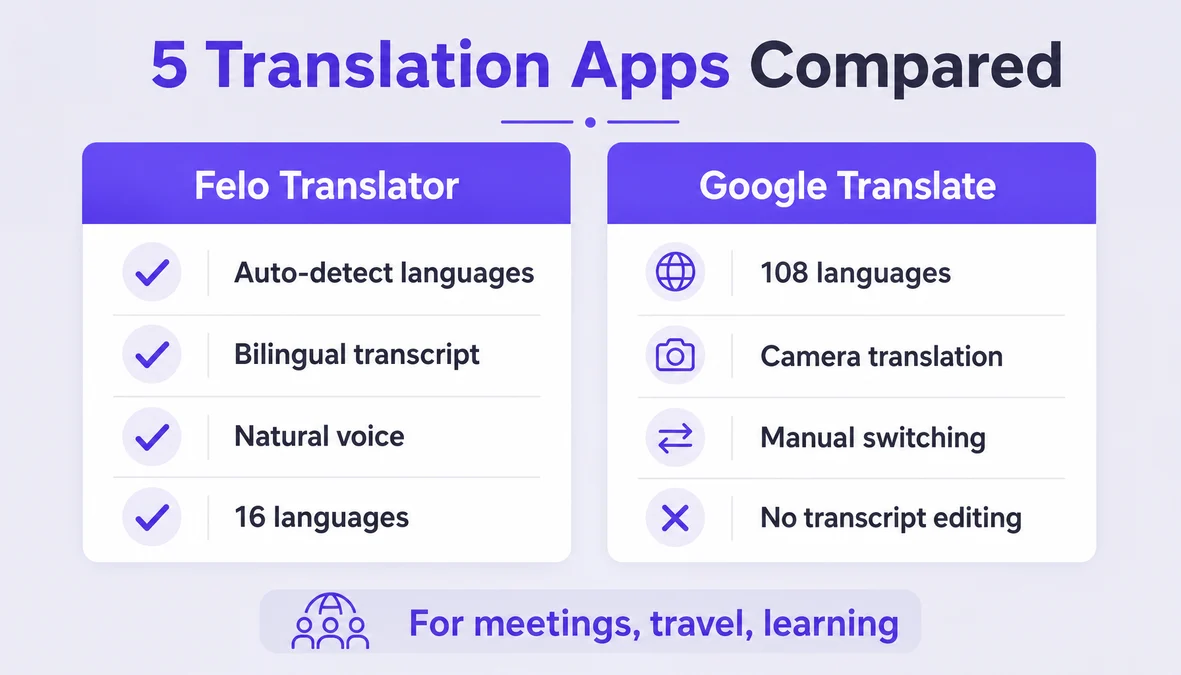
- Felo Translator (16 languages, bilingual transcript, natural voice)
- Google Translate (108 languages, conversation mode)
- Microsoft Translator (100+ languages, multi-device conversations)
Best for:
- Small meetings (2-10 people)
- Travel conversations
- Casual business discussions
- Language learning practice
What Is Simultaneous Interpretation?
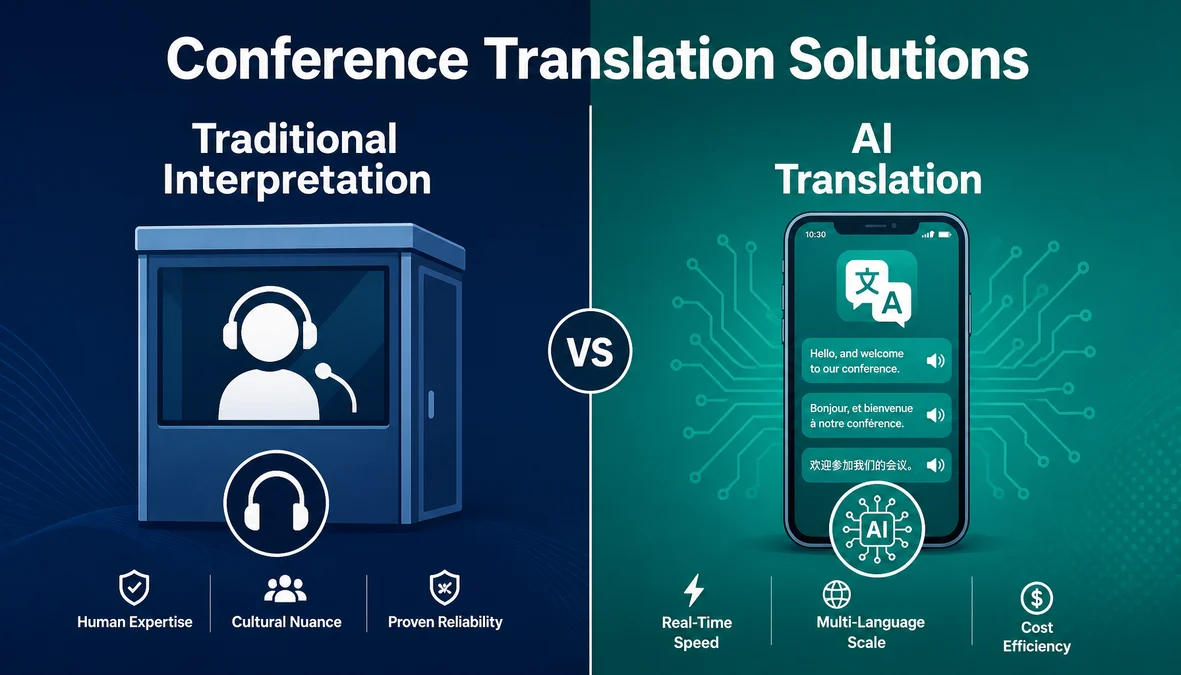
Simultaneous interpretation is performed by trained human interpreters who listen to a speaker and translate into another language at the same time. The interpreter speaks into a microphone, and listeners hear the translation through headphones, usually with less than a 1-second delay.
How it works:
- A trained interpreter listens to the speaker
- The interpreter translates in real-time, maintaining the speaker's tone and intent
- Listeners hear the translation through headphones or speakers
Common setups:
- Conference interpretation (booths, headsets, equipment)
- Remote interpretation (Zoom, Teams, Webex with interpretation channels)
- Over-the-phone interpretation (for medical, legal, customer service)
Best for:
- Large conferences (50-500+ people)
- Legal proceedings (court, depositions)
- Medical consultations (doctor-patient)
- High-stakes negotiations
- situations where accuracy is critical
Key Differences Compared
Dimension | Real-Time Translation Apps | Simultaneous Interpretation |
|---|---|---|
Who does it | Machine (AI/algorithm) | Human interpreter |
Delay | 1-3 seconds | <1 second |
Accuracy | 85-95% for common pairs, lower for technical content | 95-99% with professional interpreters |
Cost | $40-$240/year (app subscription) | $500-$2,000+/day (interpreter fee) |
Setup | Download app, start using | Book interpreter, arrange equipment |
Scalability | Works for 1-on-1 or small groups | Works for 1 person or 500+ people |
Language coverage | 16-108 languages (varies by app) | Any language pair (if interpreter available) |
Context understanding | Good for common phrases, struggles with idioms/technical terms | Excellent — interpreters understand context, culture, nuance |
Availability | 24/7, instant | Must be scheduled in advance |
When to Use Real-Time Translation Apps
Small meetings and conversations. If you're having a 1-on-1 or small group conversation (2-10 people) in common languages, a real-time translation app works well. Felo Translator's auto-detection of both speakers' languages makes two-way conversations natural.
Travel. When you're traveling and need to ask for directions, order food, or have casual conversations, a translation app is convenient and always available. You don't need to schedule anything — just open the app and start.
Language learning. If you're practicing a language and want to check your understanding in real-time, a translation app gives you instant feedback. You can speak and see the translation, helping you learn correct phrasing.
Casual business discussions. For informal business conversations where perfect accuracy isn't critical, real-time translation apps save time and money. They work well for checking understanding, not for finalizing contracts or legal agreements.
When to Use Simultaneous Interpretation
Large conferences. If you're organizing a conference with 50+ attendees who speak different languages, simultaneous interpretation is essential. Professional interpreters can handle large audiences, and attendees hear the translation through headphones without delay.
Legal proceedings. Court hearings, depositions, and legal consultations require certified interpreters. Real-time translation apps aren't accurate enough for legal contexts, where a mistranslation could have serious consequences.
Medical consultations. Doctor-patient conversations in hospitals and clinics require certified medical interpreters. Accuracy is critical — a mistranslated symptom or dosage could harm the patient.
High-stakes negotiations. Business negotiations, diplomatic meetings, and contract discussions require human interpreters who understand cultural nuances, industry terminology, and the stakes involved.
Technical content. Presentations on specialized topics (engineering, medicine, law, finance) require interpreters with domain expertise. Machine translation often struggles with technical jargon and industry-specific terms.
How Felo Translator Handles Real-Time Translation
Felo Translator is a real-time translation app that uses GPT-based speech recognition and translation. For conversations and small meetings, it auto-detects both speakers' languages and shows bilingual transcripts in real-time.
The app supports 16 languages (Korean, Japanese, German, English, Simplified Chinese, Taiwanese Mandarin, Cantonese, Czech, Thai, Spanish, French, Italian, Russian, Indonesian, Vietnamese, Nepali) and works well for casual conversations, travel, and language learning.
Felo's bilingual transcript shows both the original and translated text side by side, which is useful for reviewing conversations or studying language nuances. The app also reads translations aloud in a natural voice, so you can listen instead of reading.
For situations where you need quick, convenient translation without scheduling a human interpreter, Felo Translator is available at felo.me/translator.
FAQ
Is real-time translation as accurate as human interpretation? No — real-time translation apps are 85-95% accurate for common language pairs in quiet environments, while human interpreters achieve 95-99% accuracy. For casual conversations, app accuracy is usually sufficient. For legal, medical, or high-stakes situations, human interpreters are necessary.
Can I use a translation app for a large conference? Technically yes, but it's not ideal. Translation apps work best for small groups (2-10 people). For large conferences (50+ people), simultaneous interpretation with professional interpreters and equipment is the standard. Apps don't scale well for large audiences.
How much does simultaneous interpretation cost? Professional interpreters typically charge $500-$2,000+ per day, depending on the language pair, location, and specialization. Equipment rental (booths, headsets, microphones) adds $500-$1,500+ per day. Real-time translation apps cost $40-$240 per year.
Which is faster: real-time translation or simultaneous interpretation? Simultaneous interpretation is faster (less than 1-second delay) compared to real-time translation apps (1-3 second delay). However, for casual conversations, the difference is minimal. For fast-paced discussions or presentations, human interpreters provide a more seamless experience.
By the Felo Editorial Team. The Felo Editorial Team writes about language, voice translation, and the details of talking across borders.
Felo Translator is a real-time voice translation app in 16 languages, at felo.me/translator.