Conference Translation Solutions: Human Interpreters vs AI Tools
A two-day international conference with three language tracks. Traditional simultaneous interpretation would cost $15,000–$40,000 in interpreter fees, booth rental, and equipment. An AI-powered approach might cost $400 in software subscriptions. The quality gap has narrowed enough that the decision isn't obvious anymore.
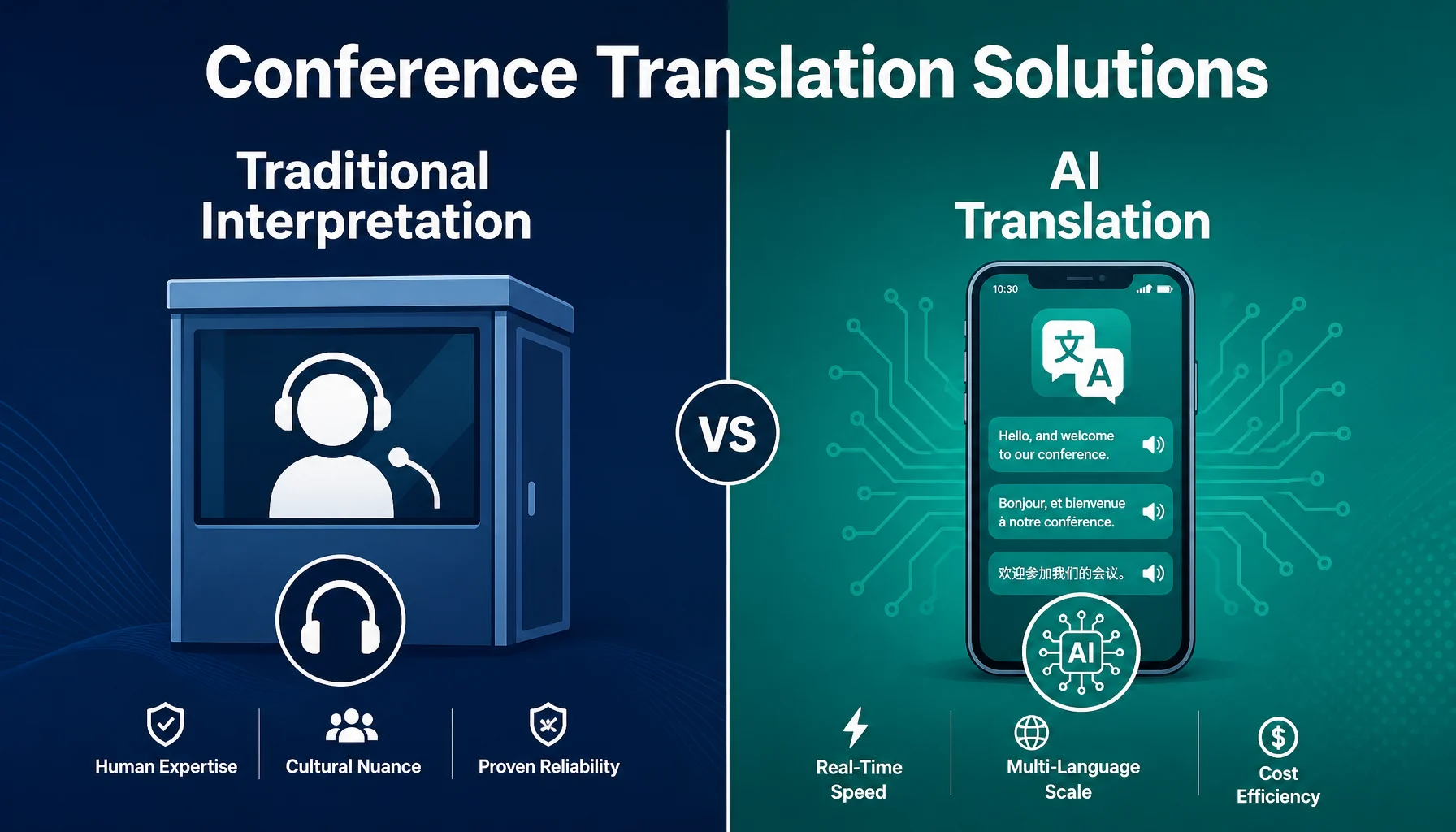
This guide compares traditional conference interpretation with modern AI translation tools across cost, quality, logistics, and use-case fit.
Before You Decide
- Estimate attendee count and language pairs. The more languages and the larger the audience, the more the cost math favors AI.
- Assess content complexity. Technical keynotes with domain jargon may still need human interpreters. Panel discussions and networking sessions are AI-friendly.
- Check venue logistics. Interpreter booths require physical space and AV infrastructure. AI tools need only Wi-Fi and attendee smartphones.
Traditional Simultaneous Interpretation
- How it works. Certified interpreters sit in soundproof booths and translate speakers' words in real time. Attendees listen through dedicated receivers tuned to their language channel.
- Cost structure. You pay per interpreter per day ($500–$1,500), plus booth rental, equipment, and travel. A three-language conference for 200 attendees over two days runs $15,000–$40,000.
- Quality profile. Human interpreters handle nuance, humor, cultural references, and domain-specific terminology well. The ceiling is very high.
- Logistics burden. Book interpreters weeks in advance, set up booths and equipment, manage on-site support. Last-minute changes require renegotiation.
- Scalability limits. Each additional language requires another interpreter. Adding a fourth language means another $1,000+/day resource.
AI Conference Translation
- How it works. Speakers talk into a microphone. Speech recognition converts words to text. Machine translation renders the text in target languages. Attendees read or listen on their phones.
- Cost structure. Software subscriptions range from free to $40–$200/month. Attendees use their own devices. For a two-day conference, incremental cost is usually under $500.
- Quality profile. AI handles general business content and conversational exchanges well. Technical presentations with heavy jargon may produce awkward output. The ceiling is lower than human interpretation.
- Logistics simplicity. No booths, no equipment rental, no advance booking. You need stable Wi-Fi, a microphone, and an app on attendee phones. Setup takes 30 minutes.
- Scalability. Adding languages is a settings change, not a hiring process. Ten languages are as easy as three.
Scenario Examples
Scenario 1: 100-person sales kickoff, English and Spanish. AI translation handles this well. General business content, good Wi-Fi, attendees read output on their phones. Cost: ~$100. A human interpreter would cost $2,000+ — unnecessary overhead.
Scenario 2: Medical research conference, English/Japanese/German, 300 specialists. Human interpreters are the right call. Highly technical content, precision matters, mistranslation could misrepresent findings. Budget: ~$25,000 for three interpreter teams over two days.
Scenario 3: Multi-day trade show, networking across 8 languages. AI translation shines. Interactions are short and conversational, spread across many language pairs. You can't afford interpreters for every combination. Attendees use a voice translation app at booths and during breaks.
Tips for Better AI Conference Translation
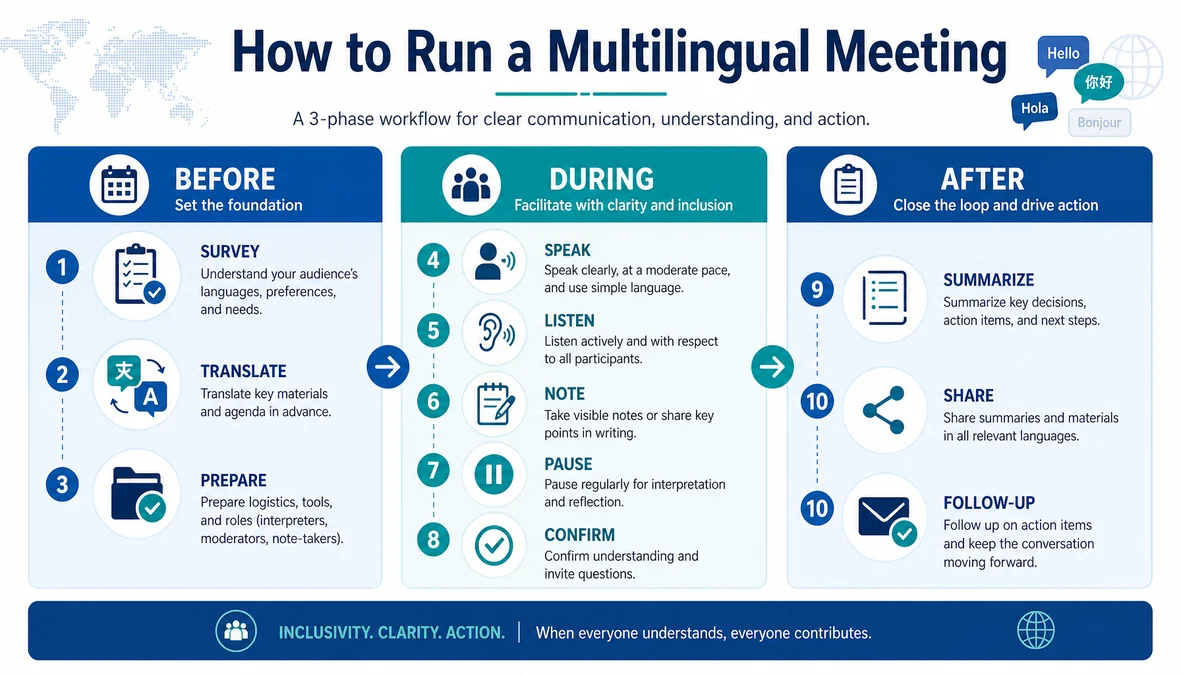
- Test the tool before the event. Run a mock session with a sample speaker. Check how it handles your vocabulary and the speaker's accent.
- Provide speakers with guidelines. Ask them to speak clearly, pause between sentences, and avoid rapid-fire lists.
- Set up a backup channel. Have a text-based option for attendees who prefer reading, or whose language isn't supported in audio output.
- Brief attendees in advance. Tell them which app to install, what languages are available, and how to connect.
- Designate a tech support person. Someone should help attendees troubleshoot connectivity or app issues.
Limitations of AI Conference Translation
- No offline mode. All tools require internet connectivity. Unreliable Wi-Fi kills the system.
- Domain jargon is hit-or-miss. Industry-specific terms and acronyms may be mistranslated. Human interpreters research the topic; AI tools don't.
- No cultural adaptation. AI translates words, not intent. Humor and cultural references come through awkwardly.
- Speaker dependency. Mumbling, rapid speech, or heavy slang reduce accuracy. You can't coach a speaker the way you coach an interpreter.
- No sign language support. Attendees who rely on sign language still need human interpreters.
How Felo Translator Fits Into Conference Settings
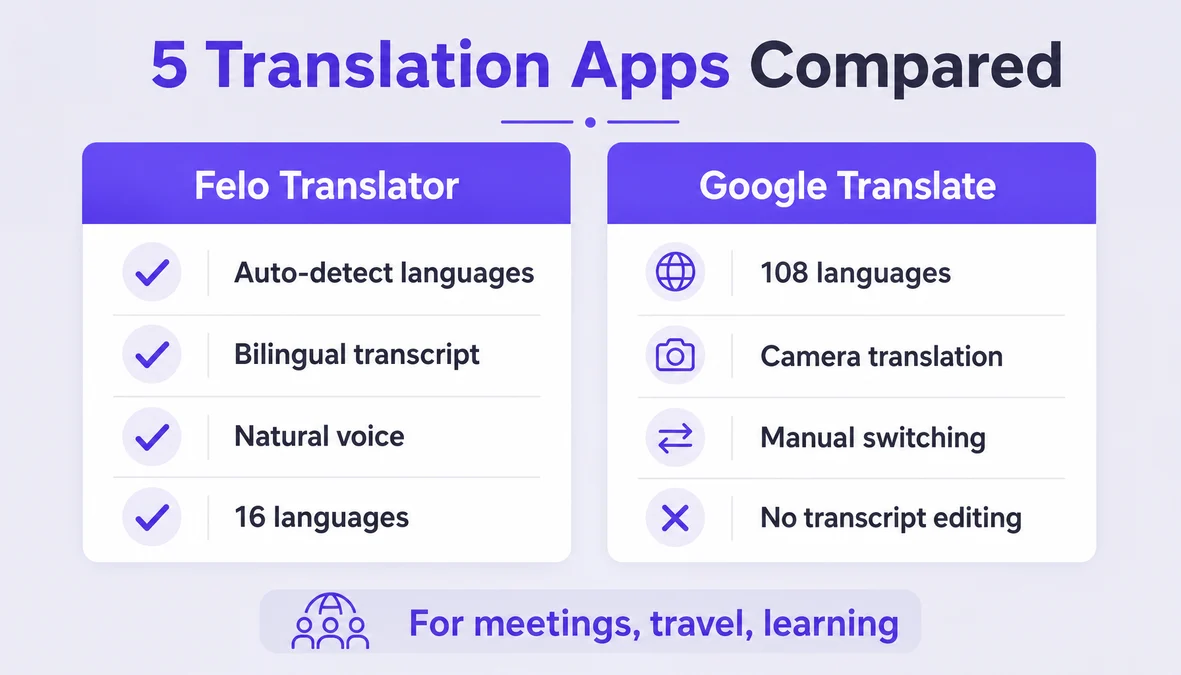
Felo Translator is a voice translation app that auto-detects both languages and produces a bilingual transcript. It supports 16 languages: Korean, Japanese, German, English, Simplified Chinese, Taiwanese Mandarin, Cantonese, Czech, Thai, Spanish, French, Italian, Russian, Indonesian, Vietnamese, and Nepali.
For conferences, Felo Translator works best for networking sessions, small group discussions, and one-on-one conversations. Available on iOS and Android.
Pricing: $0.99 for a 1-day trial, $3.90 for 120 minutes, $39.90 monthly, or $239.99 yearly. No offline mode; photo translation not included.
For keynotes or technical presentations, pair Felo Translator with human interpreters. For casual interactions and multilingual networking, the app handles the load.
Learn more at felo.me/translator.
FAQ
Can AI translation replace human interpreters at conferences? For general business content and networking, yes. For technical presentations or situations where precision is critical, no. Most conferences use a hybrid approach: human interpreters for keynotes, AI for everything else.
How accurate is AI for technical content? For common business and tech terms, 85–95%. For specialized medical, legal, or engineering jargon, 60–75%. Human interpreters with domain expertise still outperform AI.
What if the venue Wi-Fi goes down? AI translation stops working. Always have a backup: printed materials in multiple languages, bilingual staff, or an offline translation tool.
Is AI suitable for large audiences? Yes, if attendees have smartphones and the venue has strong Wi-Fi. AI scales better than interpreters — no per-attendee cost increase. The constraint is network capacity, not interpreter availability.
By the Felo Editorial Team. The Felo Editorial Team writes about language, voice translation, and the details of talking across borders.
Felo Translator is a real-time voice translation app in 16 languages, at felo.me/translator.