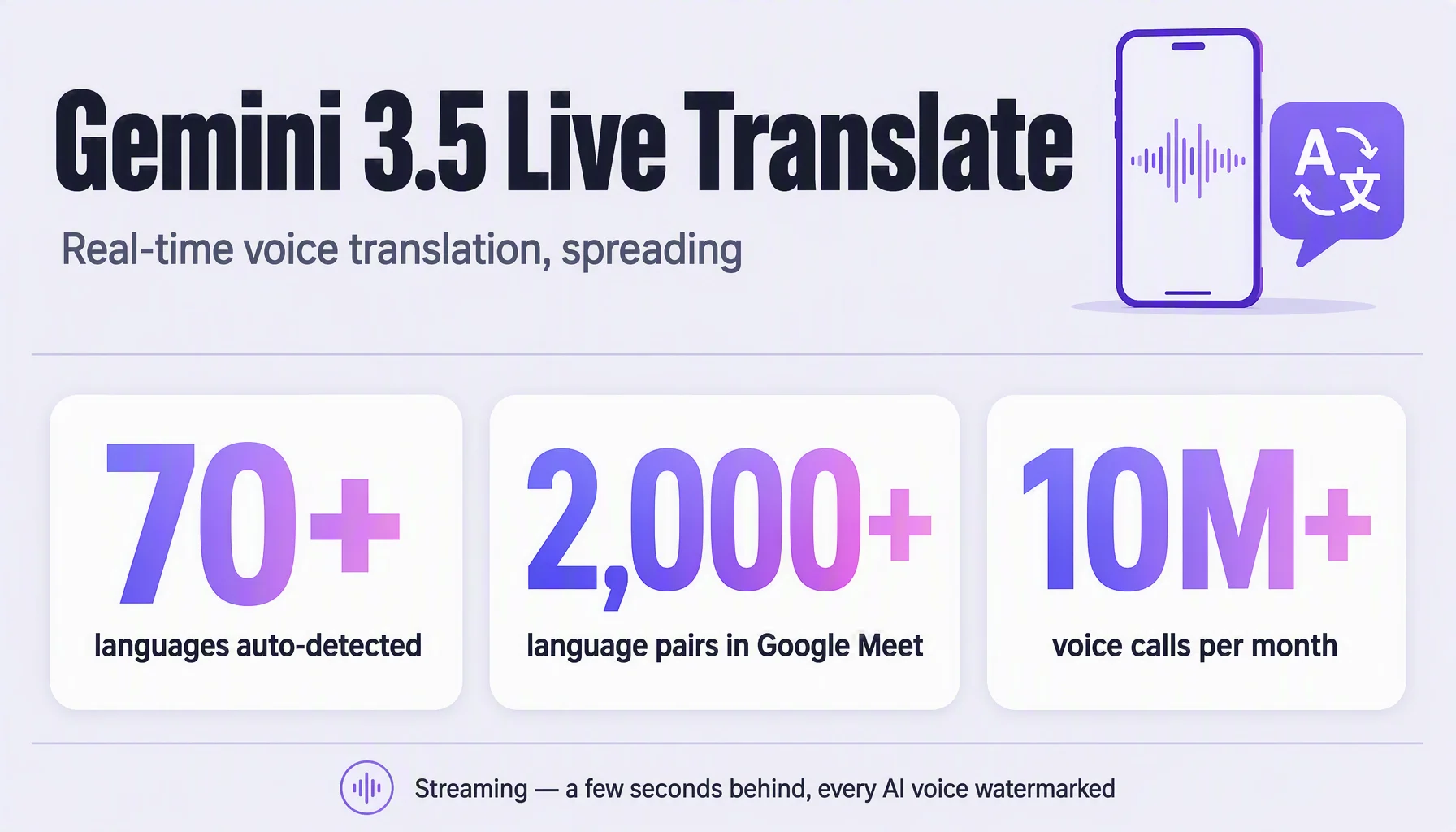
The single most consequential thing in AI voice translation right now is Google's Gemini 3.5 Live Translate — and during August 2026 it kept spreading. It is a streaming speech-to-speech model that automatically detects 70+ languages, keeps the speaker's tone and pacing, and starts translating while you are still talking, typically lagging only a few seconds. Since its June 2026 launch it has been switched on inside Google Translate on both Android and iOS, expanded Google Meet's speech translation from 5 languages to 70+ (2,000+ language pairs without going through English), and become available to developers through the Gemini Live API. Every voice it generates carries SynthID, an imperceptible AI-audio watermark.
What Gemini 3.5 Live Translate actually does differently
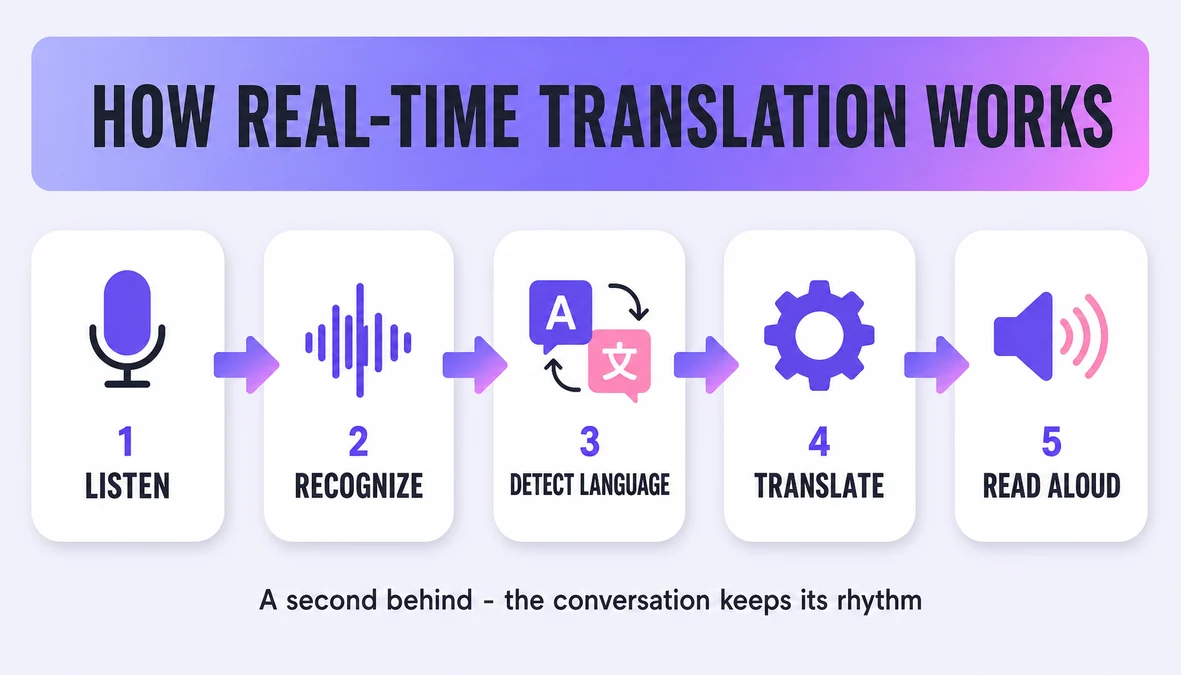
The standard real-time translator pipeline was always two hops: speech-to-text, then machine translation. Gemini 3.5 Live Translate is one end-to-end audio model — speech in, natural audio out — and it makes three practical differences visible to anyone who uses it:
- No language-pair setup. It detects the source language automatically, so you don't configure "from German to Japanese" before a conversation starts. Google says it handles 70+ languages and works with multilingual input without manual settings.
- Streaming, not sentence-by-sentence. Instead of transcribing, then translating, then speaking (which produces those awkward one-second pauses), it generates continuously — a few seconds behind the speaker, but with no gap in the flow.
- Voice stays the speaker's. It preserves tone, speed, and pitch, so the translation sounds like the person speaking, not a TTS voice reading a script. That matters for corporate demos, but it also matters at a family dinner table.
It is also designed for messy real-world audio: Google says it is robust to background noise and overlapping speech, which is what makes it plausible outside of a clean studio.
Where it shows up in August 2026
- Google Translate (Android + iOS): the model rolled out globally in the Translate app, and Android gained a "listening mode" that plays live subtitles through headphones or the phone speaker.
- Google Meet: speech translation jumped from 5 bidirectional languages (English plus Spanish, French, German, Portuguese, Italian) to 70+ languages and more than 2,000 language pairs — and translations no longer have to route through English. The expanded version started as a private preview for selected Google Workspace business customers in June and began widening during August.
- Gemini Live API (developers): the model is in public preview via the Live API and Google AI Studio. Infrastructure platforms like Agora, Fishjam, LiveKit, and Pipecat have integrated it for real-time media streaming.
- Real deployments: Grab — whose app handles more than 10 million voice calls a month — is testing it for direct multilingual conversation between drivers and riders at pickup points. Korean entertainment company CJ ENM has publicly praised the translation quality and latency.
Why the watermark matters
Translation with AI voices raises a trust problem: if a voice can be synthesized convincingly, how does anyone know it was generated? Google's answer is SynthID — every Gemini 3.5 Live Translate audio stream has an imperceptible watermark embedded in the waveform, detectable by Google's tooling. It doesn't change how the voice sounds; it makes provenance verifiable. As real-time voice translation becomes default in meeting rooms and phone calls, that becomes a compliance feature, not a footnote.
Where a dedicated translation app still earns its place
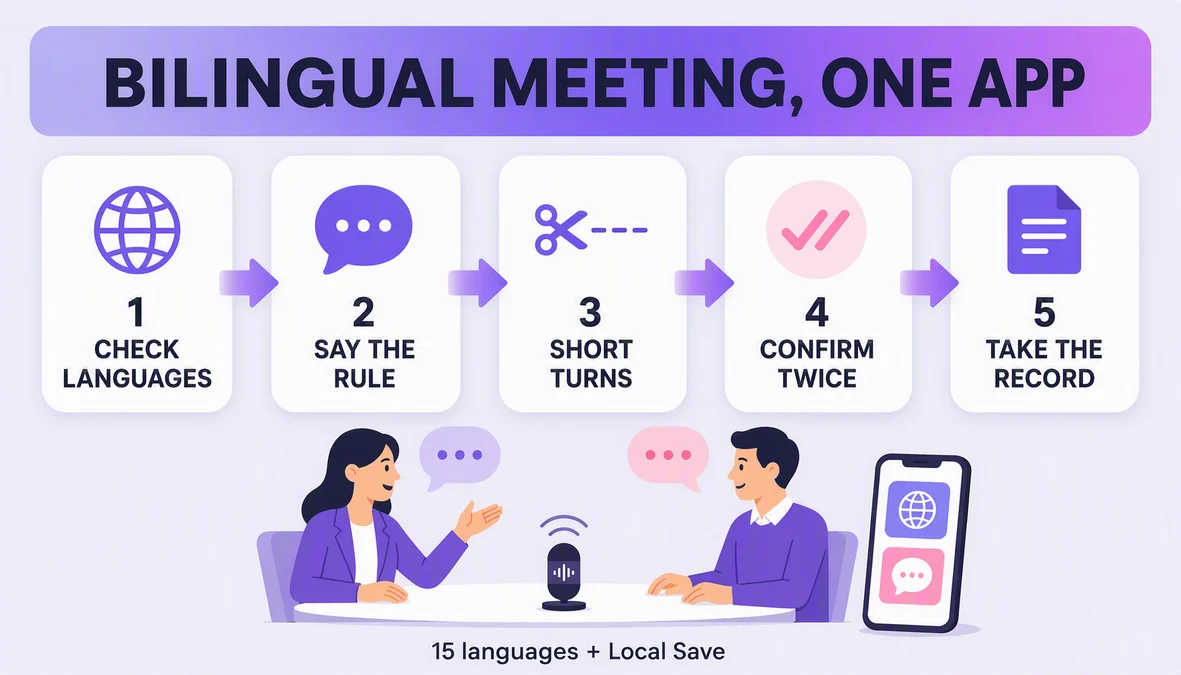
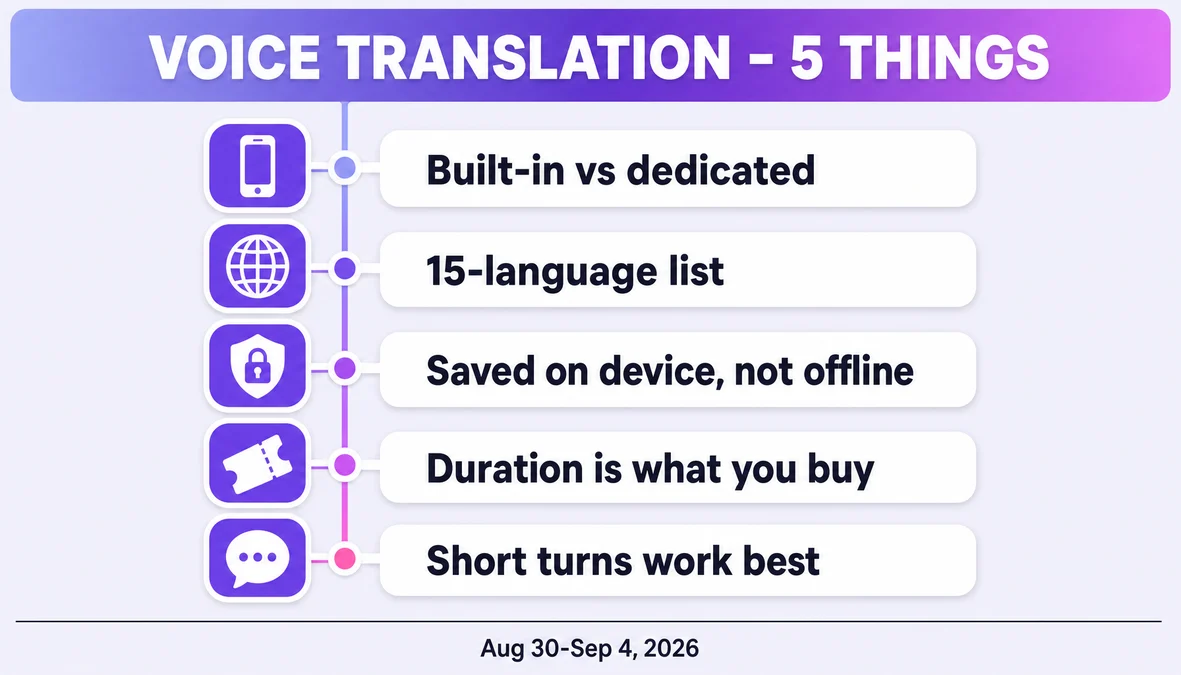
Google's live translation now lives inside its own surfaces: the Translate app, Meet, and developer integrations. Away from those — a café, a taxi, a clinic, a market stall, anywhere the other person is not opening an app — a dedicated translation app is what most people actually reach for. Felo Translator is built for that moment: a standalone real-time voice translation app for iOS and Android. Per its official product pages, it covers 15 languages with instant voice recognition — from speech to translation in one step — and lets you hear or read the result; conversations are saved locally for later reference, and it is free to try. No one has to be in the same ecosystem: you open it, you talk, the other person answers.
Which app fits is a conversation-by-conversation decision, not a numbers decision.
What this means for everyday conversation
Set-up-free, streaming, speaker-keeping translation has quietly moved from "feature" to "default" — but it still lives inside Google's ecosystem: you need the Translate app, Meet, or a developer integration. For travelers, that often means keeping a dedicated translation app alongside.
The pattern worth watching for the rest of 2026: every major voice platform now ships a live-translation answer, and audio provenance is becoming standard alongside it. The gap is no longer "can it translate," it is "can it translate naturally, in the middle of a live conversation."
FAQ
Is Gemini 3.5 Live Translate in Google Translate for free? The model is available in Google Translate on Android and iOS as part of the standard app experience — no separate purchase or subscription to access the translation model itself. Where it lives inside Google Meet, availability depends on the Workspace rollout.
How many languages does Google Meet speech translation support now? The Gemini 3.5 Live Translate expansion brought Meet speech translation to 70+ languages and more than 2,000 language pairs, up from 5 bidirectional pairs, with June and August 2026 staged rollouts to Workspace customers.
Does Gemini 3.5 Live Translate translate while a person is still talking? Yes — it is a streaming model. It does not wait for a sentence to finish; it generates continuously, usually a few seconds behind the speaker and without the pause that text-translate-then-speak pipelines produce.
If Google already translates live for free, why would anyone use a dedicated app? Google's live options are anchored to its own surfaces — Translate, Meet, developer integrations — which is exactly where they are strongest: meetings and in-app conversations. A dedicated app earns its place at conversations anywhere else: Felo Translator is a standalone iOS/Android app with 15 languages, hear-or-read output, locally saved conversations, and a free trial. There is no absolute "better" — it depends on where the conversation is happening.
By the Felo Editorial Team. The Felo Editorial Team writes about language, voice translation, and the details of talking across borders.