Felo Translator is a real-time AI voice translation app: instant voice-to-text and multilingual translation, natural read-back, on-device storage, with one hard limit — the 15 languages it supports. Before a trip, a meeting, or a family call, the check that decides everything is whether your language is on the list. This guide runs it in about a minute.
Before you check (30 seconds)
- Open felo.me/translator — that is where the current list lives.
- Write down your pair — the two languages you will actually speak: Korean ↔ English for a Seoul café, Thai at a Bangkok clinic.
- Decide whether the conversation must be kept (a clinic result, a hotel confirmation) or is a quick exchange (a taxi, a market price).
How to check your language against the 15
- Start with the table. One row per language: where it is spoken, and what that row usually carries.
Language | Where it's spoken | What you'd use it for |
|---|---|---|
English | Global | Nearly every traveler's default; the source of most business and travel conversations |
Japanese | Japan | Taxis, restaurants, shops, train stations, business meetings |
Korean | South Korea | Cafés, clinics, bookings, shopping |
Simplified Chinese | Mainland China | Markets, rides, hotels, family calls |
Taiwanese Mandarin | Taiwan | Travel, healthcare, daily errands (a distinct written form from simplified) |
Cantonese | Hong Kong / Guangdong | Local conversation where Mandarin is not the default |
Spanish | Spain / Latin America | Travel, hospitality, small business |
French | France / Francophone regions | Travel, hospitality, business |
German | Germany / Austria / Switzerland | Meetings, shops, official appointments |
Italian | Italy | Travel, restaurants, daily errands |
Russian | Russia / CIS | Travel and family conversations |
Czech | Czechia | Travel, medical visits |
Thai | Thailand | Travel, markets, clinics |
Indonesian | Indonesia | Travel, family, everyday business |
Vietnamese | Vietnam | Travel, markets, family calls |
- Match the region, not the label — a Taiwan trip reads Taiwanese Mandarin, a Hong Kong conversation reads Cantonese. Each has its own row: distinct written form from simplified, and conversation where Mandarin is not the default.
- Check the demonstrated direction. Each of the 15 is shown as a voice-translation pair with English — "Korean to English voice translation," "English to Japanese voice translation." English is the shared hub: English-facing pairs are the best-tested route.
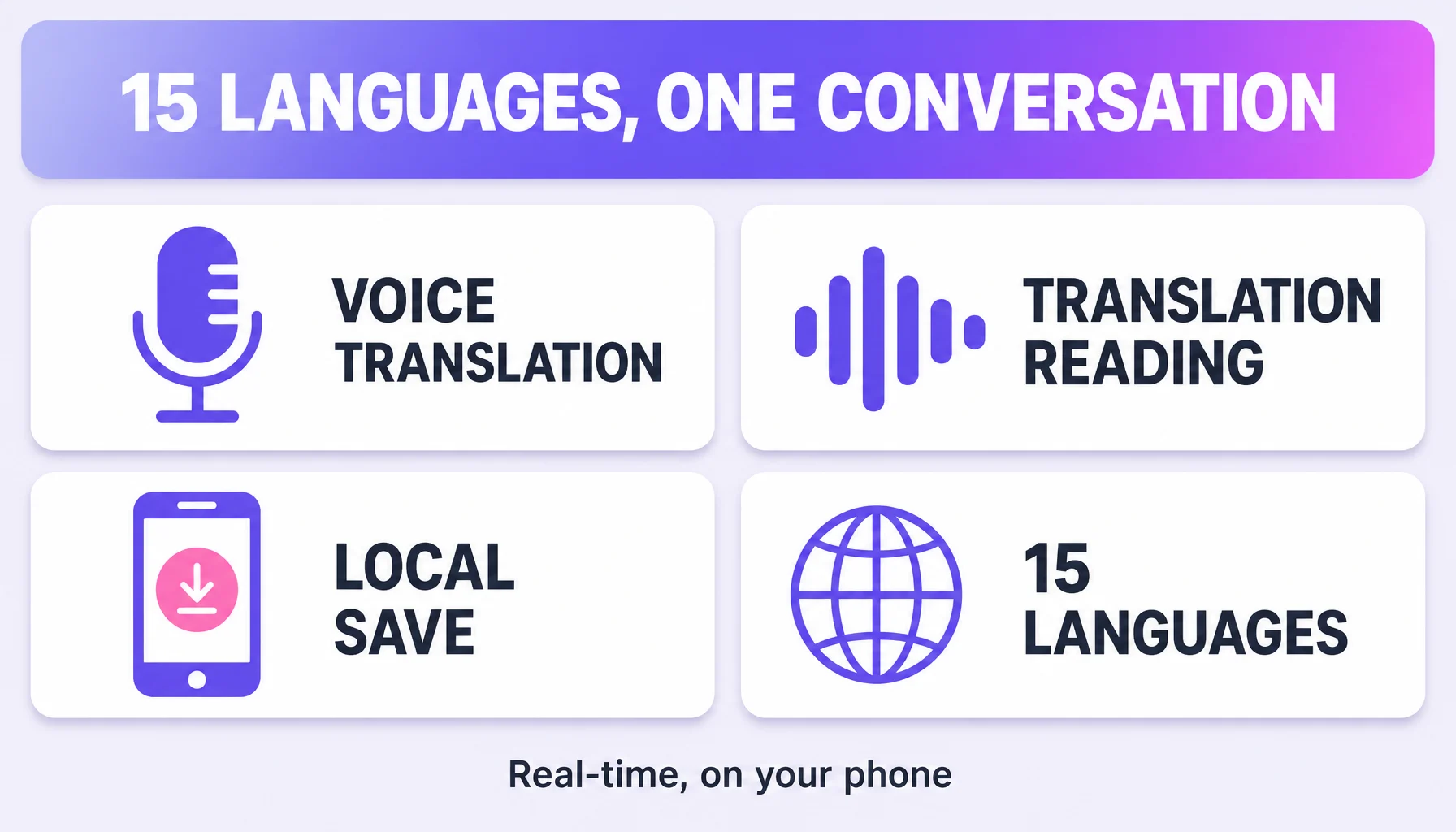
- Expect the same pipeline for every row. Recognition, translation, and reading run on the speech you actually speak — instant voice-to-text with multilingual translation; Translation Reading plays the result back with a natural cadence and a more realistic presentation of emotion and meaning; Local Save keeps it on your device for review later.
- Take the fallback path if your language is not there. The catalog is focused, not broad — Google's ecosystem advertises automatic detection of 70+ languages, Felo's set is this 15. Missing means the app is not your tool for that pair; a broad translator is the right one.
- Write the conclusion down, then re-check before you rely on it — the list is the product's supported set and it can change.
Which markets this catalog is shaped for
The list leans toward East Asia (Japanese, Korean, Simplified Chinese, Taiwanese Mandarin, Cantonese), Southeast Asia (Thai, Indonesian, Vietnamese), and European languages (English, Spanish, French, German, Italian, Russian, Czech) — the routes where voice translation apps get used the most: travel, family calls, and cross-border work. The Felo editorial blog publishes in 8 languages, including Arabic and Hebrew — that is the content side; the 15-language list is the product's supported set.
Tips that make the check smoother
- Treat the region column as your destination list. Most trips touch two rows — the local language and your own.
- Do not stop at "Chinese." Taiwanese Mandarin and Cantonese have their own rows; find the one for the actual country.
- Stay where English can join. Every language is demonstrated with English; if one side is English, you are on the best-tested route.
- The helpers do not change per row. Translation Reading's natural read-back and Local Save's on-device storage apply to every one of the 15 — checked once.
Watch out for
- Arabic and Hebrew are not in the 15. The blog publishes for those markets, but the translator's supported set does not include them — not the tool for that pair.
- Only English-facing pairs are demonstrated. A Korean-to-Japanese conversation is not separately documented — treat the English-facing route as the one you can verify.
- Focused, not broad. Outside the 15 there is no workaround inside this app; a broad translator is the right tool.
- The set can change. Verify the current list before a trip that depends on it.
FAQ
What are the 15 languages exactly? Korean, Japanese, German, English, Simplified Chinese, Czech, Thai, Spanish, French, Taiwanese Mandarin, Italian, Russian, Cantonese, Indonesian, Vietnamese — the pairs listed under "Supporting 15 Language Translations."
Do all 15 languages translate both ways with English? Each is demonstrated as a voice translation pair with English ("Korean to English voice translation," "English to Japanese voice translation"). Other direction pairs are not separately documented.
Does Felo Translator support Arabic or Hebrew? No. The 15-language list does not include Arabic or Hebrew. The blog publishes for those markets, but the app's translation set is the 15 listed above — check the current list before you depend on it.
Will my conversation be saved? Yes — Local Save stores the conversation efficiently on your device, for convenient access anytime, anywhere. This is different from a cloud conversation log: the storage is on-device.
By the Felo Editorial Team. The Felo Editorial Team writes about language, voice translation, and the details of talking across borders.