This week, AI voice translation stopped being an app-only story. Between August 17 and 22, 2026, live translation landed in consumer earbuds, Egypt launched a free Arabic-first translation AI for its whole population, AI interpretation subtitles ran the main screen of a national broadcast industry event, and new translation hardware claimed to work with no cloud at all. Here is what happened and why it matters.
The week in 30 seconds
- Translation meets earbuds — Shokz announced OpenFit 2 AI, its first AI headphones, with four live translation modes and Qwen-powered speech AI (Aug 18).
- A national Arabic translator — Egypt's Ministry of Communications launched BelMasry, a free sovereign AI platform that recognizes colloquial Arabic and translates between Arabic and 50 languages (Aug 19).
- Interpretation at broadcast scale — iFLYTEK ran real-time AI interpretation subtitles at Beijing's BIRTV 2026, the country's national broadcast and TV expo (Aug 18-22).
- Translation goes on-device — Tokyo's VMFi showed a transparent-screen interpreter at IFA 2026 plus an edge-only translation device that sends no audio to the cloud (Aug 21).
Earbuds that translate calls: Shokz OpenFit 2 AI
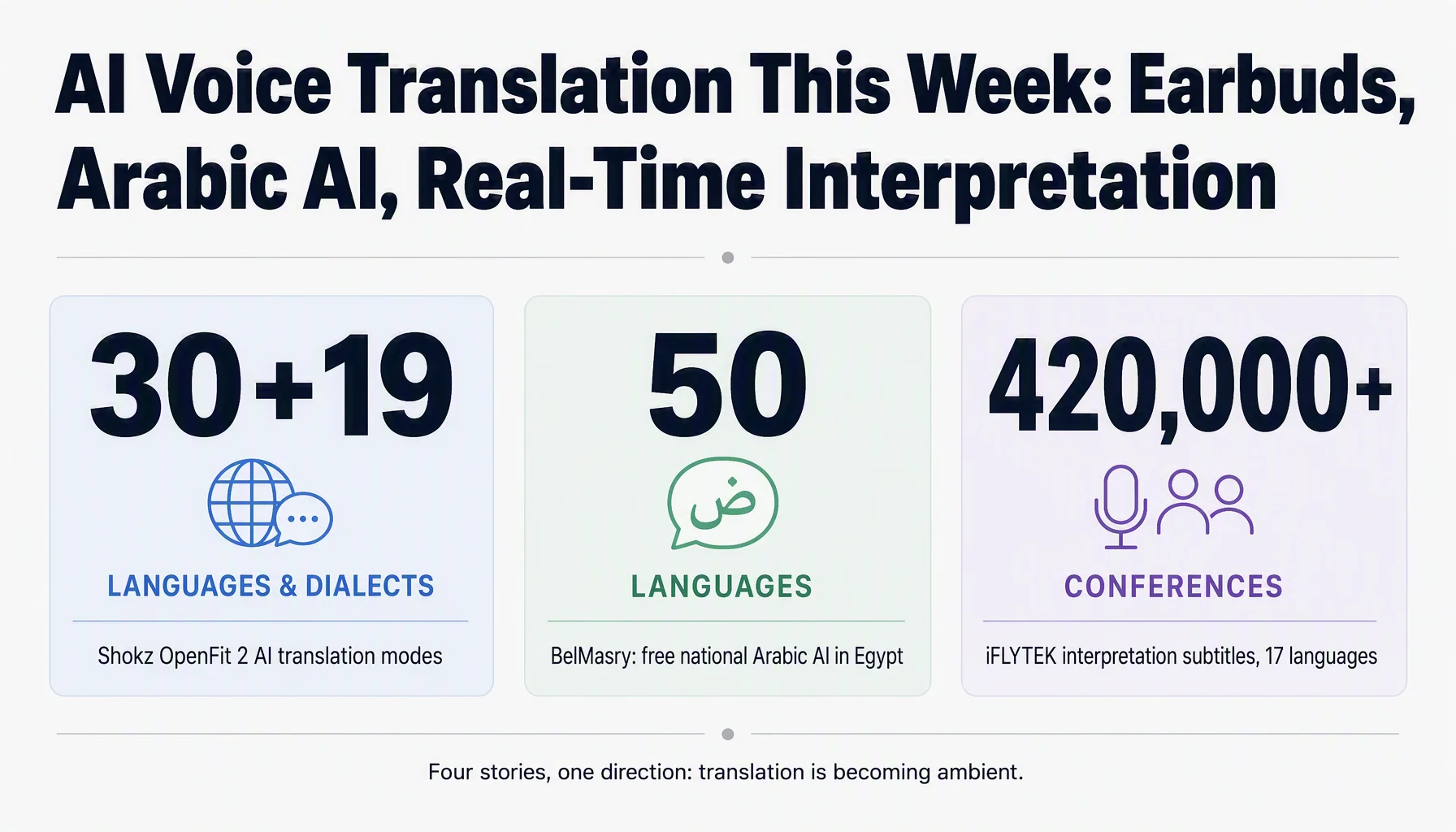
On August 18, Shokz unveiled its first AI earbuds at an event in Shanghai. The OpenFit 2 AI packs four translation modes — call translation, simultaneous interpretation, face-to-face translation, and subtitle translation for audio/video — covering 30 languages and 19 dialects, with the AI stack built on Alibaba's Qwen model. Pre-orders opened on August 17 at a launch price from ¥1,398 (about $195), with general availability on August 24.
The pattern here is broader than one product: translation is becoming a built-in ear-level feature, not a screen you open.
A country releases its own translation AI: Egypt's BelMasry
On August 19, Egypt's Ministry of Communications launched BelMasry, a free AI platform built on Egyptian linguistic data. It combines three engines: speech-to-text for Egyptian colloquial Arabic and Modern Standard Arabic (with speaker separation and noise reduction), machine translation between Arabic and 50 foreign languages, and natural-sounding Arabic text-to-speech. It is free for individuals, institutions, and developers, and is launched and operated by Egypt's Ministry of Communications.
Sovereign language AI is a trend worth watching: when a national government trains and gives away its own translation stack, the long-tail of dialects becomes a public service rather than a premium feature.
Real-time interpretation at scale: iFLYTEK at BIRTV 2026
At BIRTV 2026 in Beijing (August 18-22, China's national broadcast and television expo), iFLYTEK powered the live language barrier: its interpretation service generated real-time AI translation subtitles on the conference's big-screen stage. The company reports it has supported more than 420,000 international conferences across 50-plus countries, and its AI dubbing and translation platform now covers 17 languages.
Translation hardware that never touches the cloud
On August 21, Tokyo-based VMFi announced two next-generation translators ahead of IFA 2026, according to its corporate press release. The TransDisplay T30 combines a transparent display with a directional microphone, so both people can keep eye contact while reading the translation; VMFi says it is already deployed at a Tokyo children's center, Taipei's airports, and Taipei 101's metro station. The second device, TransEdge, is pitched as a fully edge-processed real-time translator — no audio leaves the device — designed for security-sensitive organizations. We are quoting the company's own release here; the products were not independently reviewed this week.
What this means for you
Four stories, one direction: translation is becoming ambient — on your ears, on your hardware, and inside national infrastructure. Three practical takeaways:
- Translation earbuds favor business and long calls; a dedicated voice translation app still gives you the widest combination of language coverage, speech recognition, and read-back tools on the phone you already carry.
- Free public language AI is arriving — Arabic speakers get a full national stack at no cost, a reminder that the baseline for "free translation" is rising.
- If privacy matters, edge is coming — but an on-device stack and an app that stores conversations locally are different things; check where your audio goes.
For travelers and teams that want a single handheld translator with 15 languages and natural voice read-back, Felo Translator is free to try.
FAQ
What translation features does the Shokz OpenFit 2 AI have? Four modes: call translation, simultaneous interpretation, face-to-face translation, and subtitle translation for audio/video, covering 30 languages and 19 dialects with Qwen-powered speech AI. It was announced August 18, 2026, with general availability from August 24.
Is Egypt's BelMasry platform really free? Yes. Egypt's Ministry of Communications launched BelMasry on August 19, 2026 as a free sovereign AI platform — speech recognition for Egyptian colloquial Arabic and Modern Standard Arabic, machine translation between Arabic and 50 languages, and Arabic text-to-speech — open to individuals, institutions, and developers.
Do translation earbuds replace a translation app? They complement it, not fully replace it. Earbuds make translation continuous and hands-free, while apps offer the widest language coverage and a full read-back workflow on any phone — for example, Felo Translator translates across 15 languages with natural voice reading and on-device local save.
By the Felo Editorial Team. The Felo Editorial Team writes about language, voice translation, and the details of talking across borders.