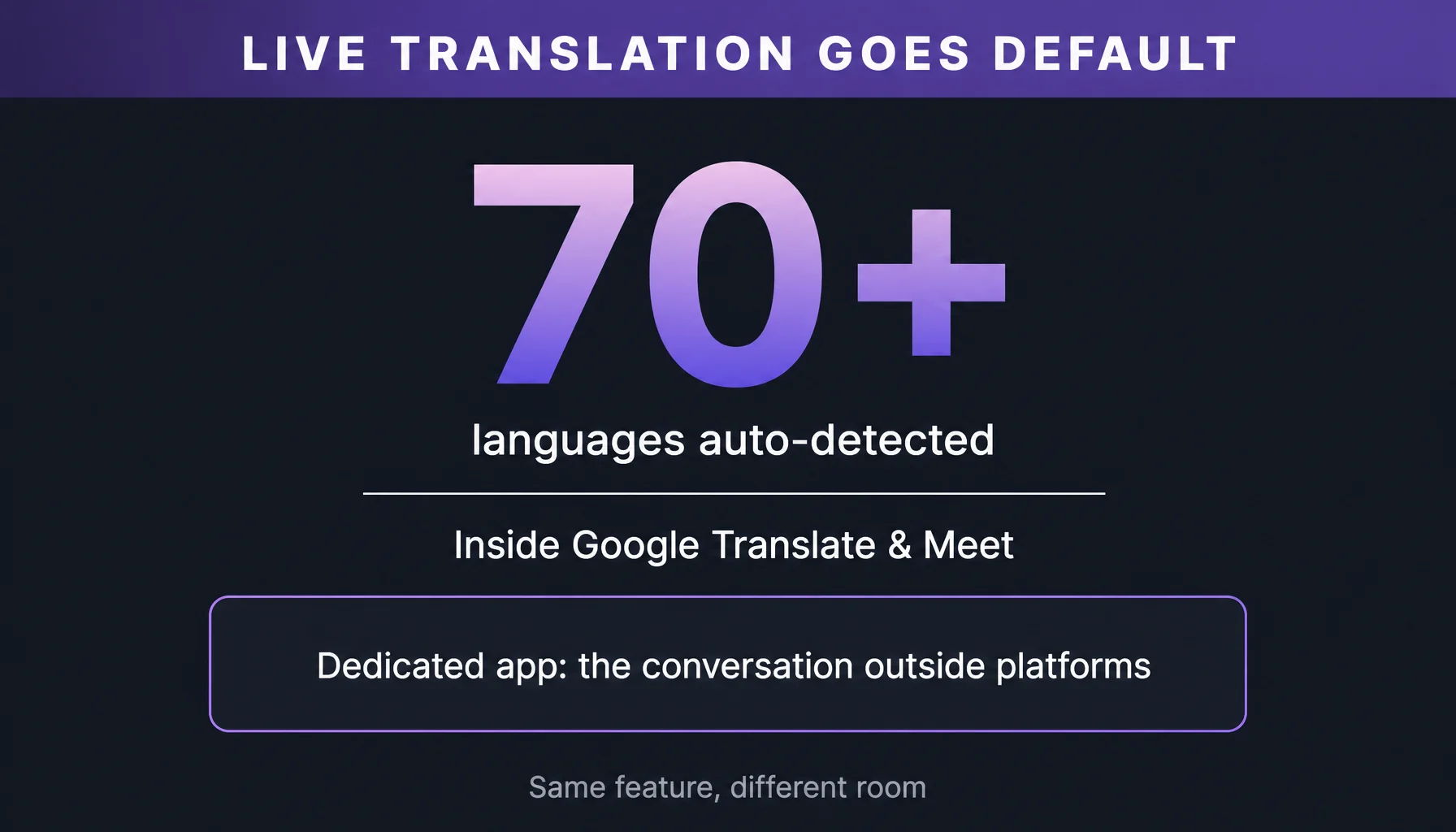
Google made live translation a standard feature in August 2026 — globally in the Translate app and inside Meet. Per Google's official announcements, Gemini 3.5 Live Translate is built into the Translate app on Android and iOS, Android gained a "listening mode" that plays live captions through headphones or the phone speaker, and Meet's speech translation grew from 5 bilingual pairs to 70+ languages and 2,000+ pairs. Here is what each of those things actually does, and what it means when the conversation is in front of you.
The features, in one lookup
Feature | The facts | What it means in a real conversation |
|---|---|---|
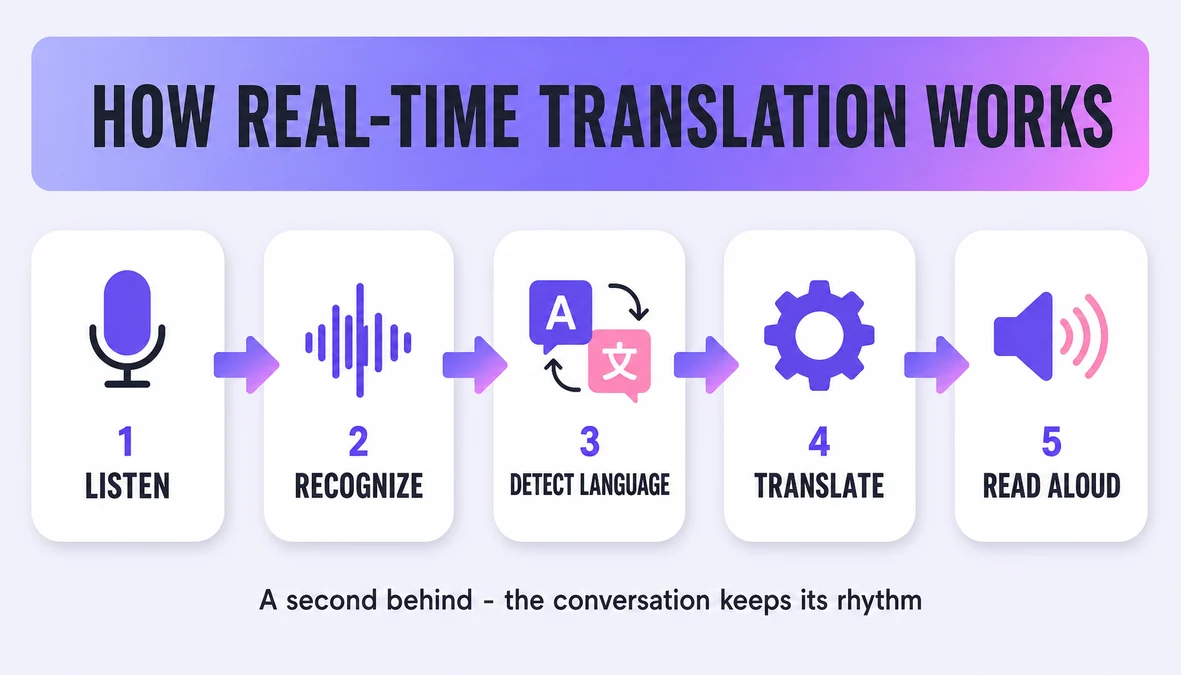
Live Translate (Translate app) | Streaming speech-to-speech built in on Android and iOS — launched June 2026, global rollout through August; no language-pair configuration; detects 70+ languages; preserves the speaker's tone and pacing; streams a few seconds behind the speaker | Two people can talk through one phone with no setup, and the translation keeps the speaker's delivery instead of flattening it |
Listening mode (Android) | Live captions played through headphones or the phone speaker | A one-sided listen: the live subtitle for a call or a lecture, not a two-way exchange |
Meet speech translation | 70+ languages and 2,000+ pairs, up from 5 bilingual pairs, without routing through English; private preview from June for select Workspace customers, widening in August | Meetings translate directly between the speakers' languages, with no English middle step |
Live API | Public preview for developers; Agora, Fishjam, LiveKit, and Pipecat integrated real-time media infrastructure | The same pipeline can reach third-party apps, so translation surfaces keep multiplying |
SynthID watermark | Every AI-generated audio stream carries an imperceptible, verifiable watermark | Any translated stream can be checked for AI generation — the watermark stays in the waveform |
The Meet numbers come from Google's Workspace communications, and the developer preview from the Live API docs.
What that changes for real conversations
Most people will never notice most of this. The part they will notice: conversations inside Google's apps now translate live, with the speaker's voice preserved. Business meetings, Meet calls, and in-app listening experiences are genuinely better.
The part that does not change: conversations that happen where there is no Google surface — a market, a taxi, a clinic, a family call started from a phone in someone's pocket. Live translation inside the apps is free and good; it is still an in-app translation.
What Felo Translator is for
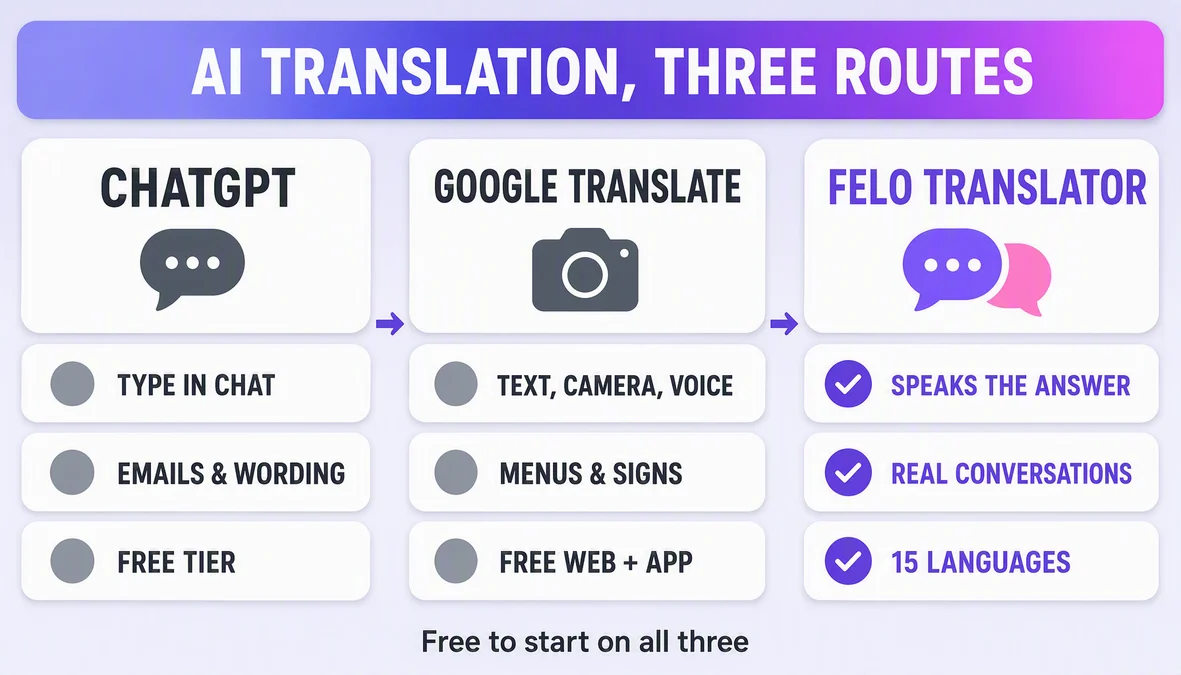
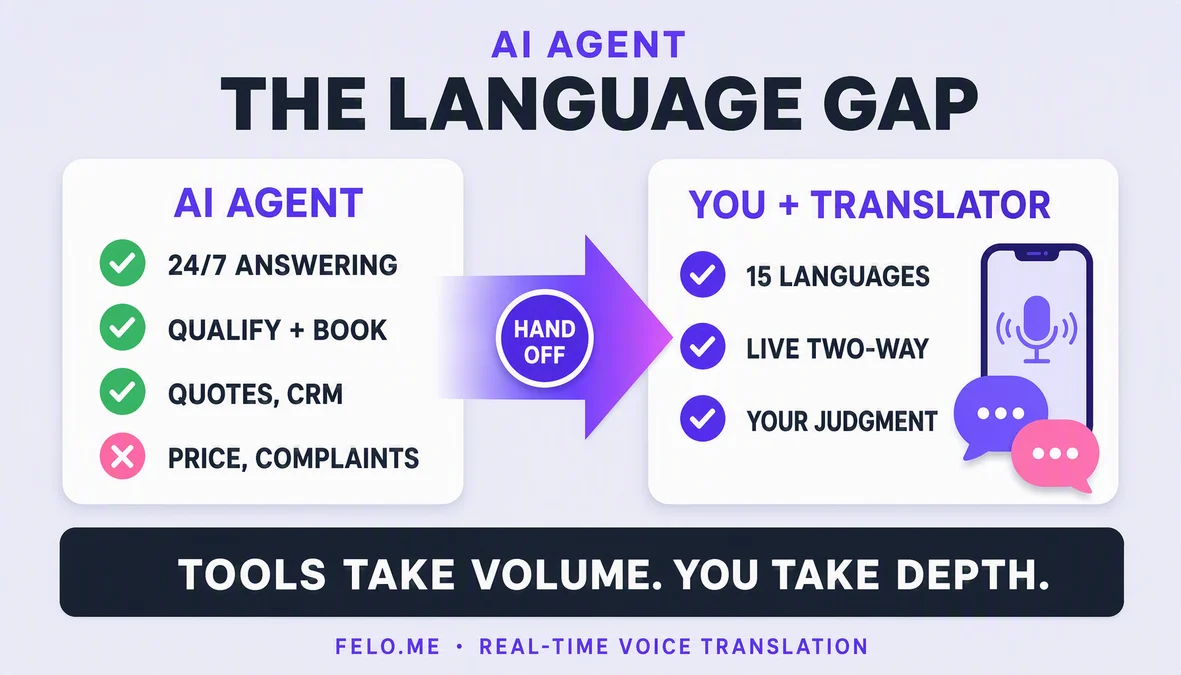
At a market stall, in a taxi, at a clinic desk, whichever app is already open on the phone is the tool — and that is the moment Felo Translator is built for. It is a standalone real-time voice translation app for iOS and Android. Per its official product pages, it covers 15 languages with instant voice recognition — from speech to translation in one step — lets you hear or read the result, saves conversations on your device for later reference, and is free to try. Nothing else has to be installed, opened, or joined: you open it, you talk, the other person answers.
Which one to reach for is a conversation-by-conversation decision, not a numbers decision. Google's live features win inside Google's surfaces; a dedicated app wins everywhere else.
FAQ
Do I still need a dedicated app if Google translates live for free? Inside Google's surfaces, no. Away from them, the question is fit: a dedicated app like Felo stays open on your phone for conversations outside apps, does not require the other person to be in the same ecosystem, and saves the conversation on your device (Local Save). Its official support list is 15 languages, so check it before relying on it.
Does Google's listening mode work on iOS? Listening mode is described for Android. Live translation itself is on both platforms — the model was built into the Translate app on Android and iOS — but the listening-mode details are Android.
Which supports more languages, Google or Felo? Google's live translation detects 70+ languages; Felo officially supports 15. That is the real trade-off: broader coverage vs. a voice-focused app with on-device saving.
Are Google's AI voices watermarked? Yes. Every audio stream generated by Gemini 3.5 Live Translate carries a SynthID watermark embedded in the waveform — verifiable with Google's tools.
One way to read the week: streaming speech-to-speech just became the default on the largest free translation surface, and the same pipeline is now open to any developer through the Live API. What it has not changed is where a conversation starts — a phone on a market table, a taxi dashboard, a clinic desk — and that moment still belongs to the app someone chooses to open.
By the Felo Editorial Team. The Felo Editorial Team writes about language, voice translation, and the details of talking across borders.